
Spiral Model: Definition, Phases, Advantages & Disadvantages
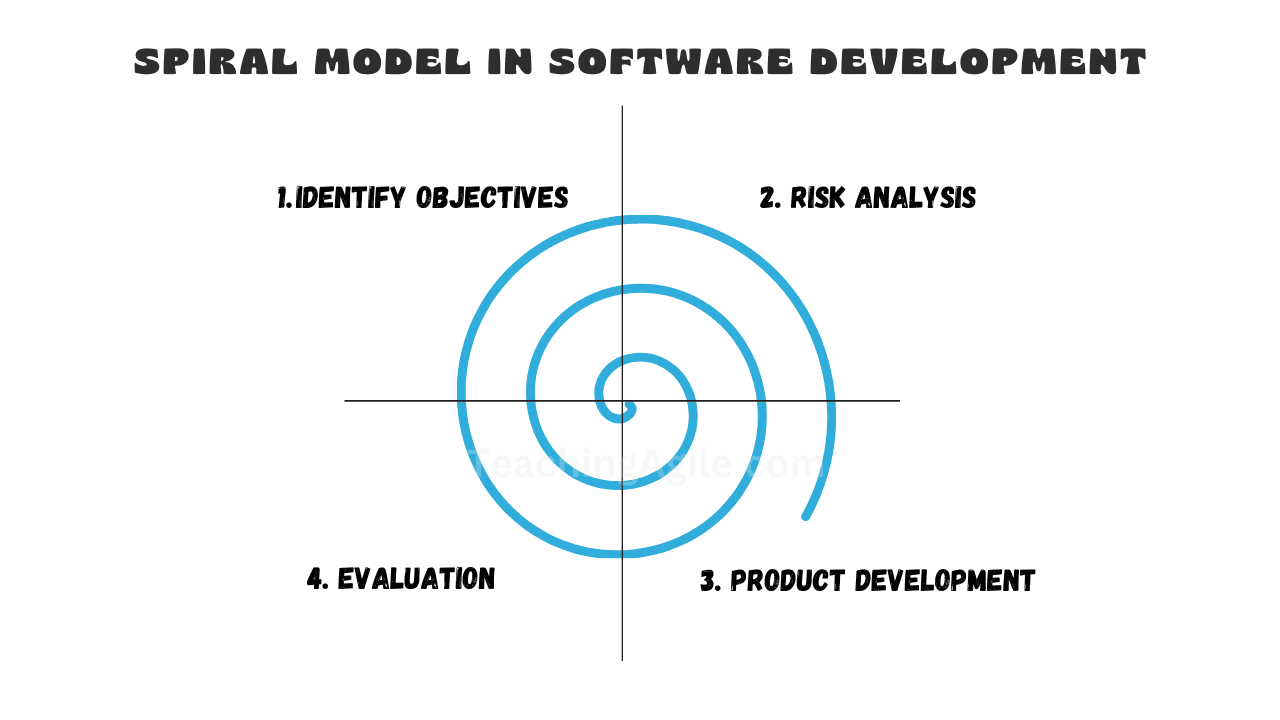 Understanding the Spiral Model in Software Development
The Spiral Model is a risk-driven software development model that combines iterative development with systematic risk management. Barry Boehm created it in 1986.
It has four phases: Planning, Risk Analysis, Engineering, and Evaluation. Each cycle (or "spiral") builds on the previous one.
Why does it matter? NASA used the Spiral Model to develop the Space Shuttle software and the Earth Observing System (EOSDIS). When failure costs are high, this model helps you catch problems early.
The radius of the spiral represents cost. The angular dimension shows progress. Each loop addresses risks before moving forward.
Quick Answer: Spiral Model at a Glance
| Aspect | Details |
|---|---|
| Creator | Barry Boehm (1986) |
| Type | Risk-driven, iterative SDLC model |
| Phases | 4 phases: Planning, Risk Analysis, Engineering, Evaluation |
| Best For | Large, complex, high-risk projects with evolving requirements |
| Key Benefit | Systematic risk management throughout development |
| Main Drawback | Higher cost and complexity than simpler models |
| Also Called | Spiral SDLC, Boehm's Spiral Model, Risk-Driven Model |
What You'll Learn
This guide covers:
- The 4 phases - Planning, Risk Analysis, Development, Evaluation
- When to use it - High-risk projects, evolving requirements, complex systems
- When NOT to use it - Small projects, fixed budgets, tight deadlines
- Real examples - NASA, e-commerce, healthcare, financial systems
- Modern integration - How to combine Spiral with DevOps and Agile
Why Does the Spiral Model Still Matter?
It's a meta-model. That means it combines the best of Waterfall, Agile, prototyping, and iterative approaches.
What can it do?
- Adapt to uncertainty through continuous risk assessment
- Deliver value incrementally
- Scale from prototypes to enterprise systems
- Work with modern DevOps and cloud practices
When to use it: High failure costs, uncertain requirements, critical stakeholder involvement. NASA used it for the Space Shuttle. That tells you something.
Índice-
- What is the Spiral Model?
- The Four Phases of the Spiral Model
- Enhanced Risk Management Strategies
- Real-World Implementation Examples
- Technical Implementation Details
- Decision Framework for Model Selection
- Project Types and Applications
- Management Challenges and Solutions
- Common Spiral Model Mistakes to Avoid
- Modern Context and Hybrid Approaches
- Advantages of the Spiral Model
- Disadvantages of the Spiral Model
- Triple Constraint in the Spiral Model
- Why is the Spiral Model Called a Meta Model?
- Personal Experiences and Insights
- Conclusion
- Quiz on Spiral Model
- Continue Reading
- Frequently Asked Questions
What is the Spiral Model?
Definition: The Spiral Model is a risk-driven development approach where you build software in cycles, assessing and mitigating risks at each turn.
It's different from Waterfall. Instead of one long sequence, you go through multiple spirals.
Each spiral builds on the last. You learn, adapt, and reduce risk as you go.
What makes it powerful?
- You address problems as they emerge
- Stakeholders give feedback at every cycle
- Both the product AND the process improve over time
Historical Context: Barry Boehm's Innovation
Barry Boehm published "A Spiral Model of Software Development and Enhancement" in 1986. It was a response to Waterfall's limitations.
The problem? Waterfall couldn't handle uncertainty. Large projects had evolving requirements. Linear approaches failed.
Boehm's insight: Put risk analysis at the center. Don't just build - assess risks first, then build.
He developed this approach working on aerospace and defense projects. When failure costs millions (or lives), you can't skip risk assessment.
NASA adopted it for the Space Shuttle and EOSDIS projects. The model proved itself where it mattered most.
Visual Representation and Structure
The spiral diagram tells you everything at a glance. Here's how to read it:
Understanding the Spiral Diagram
-
Radius (distance from center) = Cumulative cost. The further out, the more you've invested.
-
Angular dimension = Progress through phases. One full rotation = one complete spiral.
-
Multiple loops = Multiple iterations. Each loop builds on previous work.
-
Expanding scope = Growing complexity. More features, more detailed requirements.
Quadrant-Based Framework
The Spiral Model organizes its activities into four distinct quadrants. Each quadrant represents a different focus area:
| Quadrant | Primary Focus | Key Activities | Deliverables |
|---|---|---|---|
| Quadrant 1 | Objective Setting | Requirements analysis, alternative identification | Requirements document, project constraints |
| Quadrant 2 | Risk Analysis | Risk assessment, prototyping, simulation | Risk analysis report, prototypes, mitigation strategies |
| Quadrant 3 | Development | Design, coding, testing, integration | Working software, test results, documentation |
| Quadrant 4 | Planning | Review, evaluation, next iteration planning | Evaluation report, next iteration plan, stakeholder feedback |
This quadrant structure ensures that each iteration addresses all critical aspects of software development. It maintains focus on risk management and stakeholder value.
The 4 Phases of the Spiral Model
Every spiral goes through four phases. No exceptions.
| Phase | What Happens | Key Question |
|---|---|---|
| 1. Planning | Define objectives and constraints | What are we building? |
| 2. Risk Analysis | Identify and mitigate risks | What could go wrong? |
| 3. Engineering | Build and test | Does it work? |
| 4. Evaluation | Review with stakeholders | Should we continue? |
Each phase has specific deliverables. Let's break them down.
Phase 1: Planning (Identification)
What are we building this cycle? That's the core question.
This phase sets the foundation. You can't build well if you don't know what you're building.
Key Activities:
- Define objectives for this iteration
- Identify stakeholders and their expectations
- Explore alternative approaches
- Document constraints (budget, time, resources)
- Set measurable success criteria
Deliverables:
- Requirements specification
- Stakeholder analysis
- Alternative solution proposals
- Constraints documentation
- Success criteria
⚠️
Don't skip stakeholder alignment here. Misaligned objectives cascade through the entire iteration.
Phase 2: Risk Analysis
This is what makes Spiral different. Risk analysis isn't an afterthought - it's the core activity.
What could go wrong? Find out NOW, not after you've built the thing.
Types of Risks to Identify:
- Technical - Performance, scalability, integration
- Schedule - Unrealistic timelines, resource availability
- Cost - Budget overruns, scope creep
- External - Market changes, regulations, third-party dependencies
- Resource - Skill gaps, team availability
How to Analyze Risks:
- Build prototypes to validate technical approaches
- Run Monte Carlo simulations for cost/schedule estimates
- Use risk matrices to prioritize
- Get expert judgment through Delphi method
Mitigation Strategies:
| Risk Level | Strategy | Example |
|---|---|---|
| High | Avoid or Transfer | Change architecture, outsource risky parts |
| Medium | Mitigate | Add contingency plans, allocate more resources |
| Low | Accept | Monitor it, document impact, prepare responses |
Deliverables: Risk register, mitigation plans, prototype demos
Phase 3: Product Development (Construct/Build)
Now you build. Turn plans into working software.
This follows a mini-waterfall within the spiral: Design → Development → Testing → Deployment.
What You Do:
- Create technical specifications from risk analysis findings
- Write code following your coding standards
- Unit test individual components
- Integrate and test system parts together
- Run user acceptance testing
For High-Risk Areas:
Build a Proof of Concept (POC) first. Validate before committing.
- Test if your technology choice actually works
- Verify your architecture is viable
- Check interfaces between components
Quality Assurance:
- Automate testing throughout
- Do code reviews
- Monitor performance
- Validate security
Deliverables: Working software, documentation, test results
Phase 4: Evaluation (Plan Next Iteration)
Did it work? What did we learn? Should we continue?
This is your retrospective. Like Agile retrospectives, but with more formal risk reassessment.
What You Do:
- Compare deliverables against success criteria
- Get stakeholder feedback
- Evaluate team performance
- Update the risk register with new insights
- Document lessons learned
Stakeholder Activities:
- Demo working software
- Refine requirements based on feedback
- Adjust priorities
- Modify scope if needed
The Big Decision:
| Decision | When | Outcome |
|---|---|---|
| Continue | Positive ROI, stakeholders happy | Next spiral |
| Modify | Partial success, improvements needed | Adjust approach |
| Terminate | Negative ROI, insurmountable risks | Controlled shutdown |
Deliverables: Evaluation report, updated plan, revised risk assessment
This is where you decide: go, change, or stop. Don't skip this phase.
Enhanced Risk Management Strategies
The Spiral Model puts risk analysis at the center of every iteration. Other methodologies treat risk as secondary - Spiral doesn't.
This creates a solid framework for managing uncertainty. You can't eliminate risk, but you can spot it early.
Quantitative Risk Assessment Techniques
Quantitative risk assessment provides measurable data for making informed decisions about risk prioritization and resource allocation.
Monte Carlo Simulation:
- Purpose: Model project outcomes under various scenarios
- Application: Estimate completion dates, budget requirements, and success probabilities
- Benefits: Provides statistical confidence intervals for project planning
- Tools: @RISK, Crystal Ball, Monte Carlo simulation software
Expected Monetary Value (EMV) Analysis:
- Formula: EMV = Probability × Impact
- Use Case: Prioritize risks based on financial impact
- Example: A 20% chance of a $50,000 cost overrun has an EMV of $10,000
Risk Exposure Calculation:
- Methodology: Combine probability and impact assessments
- Scaling: Use consistent scales (e.g., 1-5 for probability, monetary values for impact)
- Aggregation: Calculate total project risk exposure across all identified risks
Qualitative Risk Assessment Methods
Qualitative methods provide context and understanding for risks that are difficult to quantify.
Risk Probability and Impact Matrix:
| Probability | Very Low Impact | Low Impact | Medium Impact | High Impact | Very High Impact |
|---|---|---|---|---|---|
| Very High | Medium | High | High | Very High | Very High |
| High | Low | Medium | High | High | Very High |
| Medium | Low | Low | Medium | High | High |
| Low | Very Low | Low | Low | Medium | High |
| Very Low | Very Low | Very Low | Low | Low | Medium |
Expert Judgment Techniques:
- Delphi Method: Anonymous expert consensus building
- Brainstorming Sessions: Collaborative risk identification
- Root Cause Analysis: Identify underlying risk sources
- Scenario Planning: Explore "what-if" situations
Risk Prioritization and Mitigation
Risk Response Strategies:
- Avoid: Eliminate the risk by changing project approach
- Transfer: Share risk with third parties (insurance, contracts)
- Mitigate: Reduce probability or impact through specific actions
- Accept: Acknowledge risk and prepare contingency plans
Mitigation Planning Framework:
- Preventive Actions: Steps to reduce risk probability
- Corrective Actions: Responses if risk occurs
- Contingency Plans: Alternative approaches if primary mitigation fails
- Monitoring Triggers: Indicators that risk levels are changing
Real-World Implementation Examples
The Spiral Model's flexibility and risk-focused approach make it particularly suitable for complex, high-stakes projects across various domains. Here are detailed examples of successful Spiral Model implementations.
E-commerce Platform Development
Project Context: A mid-sized retail company needed to build an e-commerce platform. They had to compete with online giants while integrating with existing inventory and customer systems.
Spiral Implementation:
Iteration 1: Core Foundation (Months 1-3)
- Objectives: Establish basic user authentication and product catalog
- Risk Analysis: Technology stack selection, integration with legacy systems
- Development: Proof-of-concept user registration and product display
- Evaluation: Stakeholder feedback on user experience and performance
Iteration 2: Shopping Experience (Months 4-6)
- Objectives: Implement shopping cart and basic checkout functionality
- Risk Analysis: Payment integration security, scalability concerns
- Development: Shopping cart, secure payment processing integration
- Evaluation: Load testing results, security audit findings
Iteration 3: Advanced Features (Months 7-9)
- Objectives: Add recommendation engine and mobile responsiveness
- Risk Analysis: Algorithm complexity, cross-device compatibility
- Development: Machine learning recommendations, responsive design
- Evaluation: A/B testing results, mobile performance metrics
Iteration 4: Optimization and Launch (Months 10-12)
- Objectives: Performance optimization and production deployment
- Risk Analysis: Launch timing, competitive response, scaling requirements
- Development: Performance tuning, monitoring systems, deployment automation
- Evaluation: Production readiness assessment, launch success metrics
Results:
- Significant reduction in time-to-market compared to traditional waterfall approach
- Early risk identification prevented major security vulnerabilities
- Iterative feedback led to substantial improvement in user experience metrics
- Minimal budget variance due to effective risk management and early issue detection
Enterprise Software Solutions
Project Context: A large manufacturing company required a custom Enterprise Resource Planning (ERP) system to replace multiple legacy systems while maintaining business continuity.
Spiral Advantages in This Context:
- Complex Integration Requirements: Multiple legacy systems with varying data formats
- High Business Risk: Any disruption to manufacturing processes would be costly
- Evolving Requirements: Business processes evolved during development
- Large Stakeholder Base: Multiple departments with conflicting priorities
Key Success Factors:
- Incremental Rollout: Each spiral delivered a functional module
- Parallel Operation: New system ran alongside legacy systems during transition
- Extensive Prototyping: Reduced integration risks through early testing
- Stakeholder Involvement: Regular feedback prevented requirement misalignment
Mobile Application Development
Project Context: A healthcare startup needed to develop a patient monitoring app with strict regulatory compliance requirements and uncertain market demands.
Spiral Benefits:
- Regulatory Compliance: Iterative approach allowed for early compliance validation
- Market Uncertainty: User feedback guided feature prioritization
- Technical Challenges: Complex integration with medical devices
- Rapid Evolution: Healthcare regulations and market needs changed during development
Implementation Highlights:
- Regulatory Spiral: Dedicated iteration for compliance validation and quality assurance
- User Testing: Each spiral included extensive user testing with healthcare professionals
- Device Integration: Incremental integration with different medical devices
- Security Focus: Security assessment in every spiral due to sensitive health data, following SDLC security best practices
Technical Implementation Details
The Spiral Model's technical implementation requires careful attention to integration points, version management, and quality assurance throughout the iterative development process.
Verification and Validation Integration
Verification Activities (Are we building the product right?):
- Code Reviews: Peer review of all code changes before integration
- Static Analysis: Automated code quality and security analysis
- Unit Testing: Comprehensive test coverage for individual components
- Integration Testing: Validate interfaces between system components
- Performance Testing: Ensure system meets performance requirements
Validation Activities (Are we building the right product?):
- User Acceptance Testing: Stakeholder validation of functionality
- Prototype Demonstrations: Early validation of concepts and approaches
- Requirements Traceability: Ensure all requirements are addressed
- Stakeholder Reviews: Regular feedback sessions throughout development
- Market Validation: Test assumptions about user needs and market demand
V&V Integration Framework:
| Spiral Phase | Verification Focus | Validation Focus |
|---|---|---|
| Planning | Requirements consistency | Stakeholder alignment |
| Risk Analysis | Risk mitigation effectiveness | Prototype user feedback |
| Development | Code quality and standards | Functional correctness |
| Evaluation | Process compliance | Business value delivery |
Continuous Integration Aspects
While the Spiral Model predates modern CI/CD practices, contemporary implementations can benefit significantly from continuous integration principles.
CI Implementation in Spiral Development:
- Automated Build Pipelines: Trigger builds on code commits within each spiral
- Continuous Testing: Run automated test suites for every code change
- Quality Gates: Prevent progression to next spiral phase without meeting quality criteria
- Deployment Automation: Streamline deployment processes for prototype and production releases
Integration Challenges and Solutions:
| Challenge | Solution | Implementation |
|---|---|---|
| Long Iteration Cycles | Incremental integration | Daily builds and integration testing |
| Complex Dependencies | Dependency management | Automated dependency tracking and resolution |
| Quality Assurance | Automated testing | Comprehensive test automation suite |
| Configuration Management | Version control | Git branching strategies for spiral iterations |
Build Versioning Through Iterations
Versioning Strategy:
- Major Version: Incremented for each spiral iteration
- Minor Version: Feature additions within a spiral
- Patch Version: Bug fixes and minor enhancements
- Build Number: Automatic increment for each build
Example Versioning Scheme:
- Spiral 1: v1.0.0 (Initial core functionality)
- Spiral 2: v2.0.0 (Enhanced features with risk mitigation)
- Spiral 3: v3.0.0 (Advanced capabilities)
- Production Release: v3.1.0 (Final optimizations)
Artifact Management:
- Binary Repositories: Store compiled artifacts for each iteration
- Documentation Versioning: Maintain documentation aligned with code versions
- Environment Consistency: Ensure consistent environments across iterations
- Rollback Capabilities: Ability to revert to previous spiral versions if needed
When to Choose the Spiral Model
The Spiral Model excels in specific scenarios where systematic risk management provides maximum value. Understanding how it compares to other methodologies helps you make the right choice.
Spiral Model vs Other SDLC Models: Quick Comparison
| Aspect | Spiral Model | Waterfall | Agile | Iterative Model |
|---|---|---|---|---|
| Risk Management | Systematic risk analysis in every iteration | Minimal formal risk management | Implicit through rapid feedback | Some risk consideration |
| Flexibility | High - adapts at each spiral | Very low - sequential phases | Very high - continuous adaptation | Medium - fixed iteration scope |
| Documentation | Comprehensive but iterative | Extensive upfront documentation | Minimal, just-in-time | Moderate documentation |
| Project Size | Large to very large projects | Medium to large projects | Small to medium projects | Small to large projects |
| Cost | Higher due to risk analysis | Lower for simple projects | Lower for simple projects | Moderate cost |
| Timeline Predictability | Moderate - assessed per spiral | High - defined upfront | Low - emergent timeline | Moderate predictability |
| Customer Involvement | Regular at evaluation phases | Limited after requirements | Continuous daily involvement | Regular at iteration ends |
| Best For | High-risk, evolving requirements | Stable requirements, low risk | Rapid feedback, flexible scope | Refinement through cycles |
| Requirements Stability | Evolving requirements expected | Stable, well-defined upfront | Continuously changing | Gradually refined |
| Team Experience Required | High - risk management skills | Medium - process following | High - self-organization | Medium - iterative skills |
Detailed Methodology Comparisons
Spiral vs. Waterfall Model: When risk management trumps predictability
Learn when to choose Spiral's adaptive risk management over Waterfall's sequential certainty. This guide covers decision criteria, cost implications, and real examples.
Spiral vs. Agile Methodologies: Formal risk analysis vs. rapid feedback
Understand the key differences between Spiral's systematic risk management and Agile's rapid iteration. Learn when formal risk analysis matters - and when rapid feedback works better.
Spiral vs. Iterative Model: Understanding the meta-model advantage
Explore how Spiral's risk-driven approach enhances traditional iterative development. Learn when systematic risk management justifies the additional overhead and how to choose between these iterative approaches.
Decision Framework for Model Selection
Risk Assessment Matrix:
| Risk Level | Requirement Stability | Recommended Model |
|---|---|---|
| High | Unstable | Spiral Model |
| High | Stable | Waterfall with Risk Management |
| Medium | Unstable | Agile or Spiral |
| Medium | Stable | Iterative or Agile |
| Low | Unstable | Agile |
| Low | Stable | Waterfall |
Selection Criteria Checklist:
- Project Complexity: Is the project technically complex or innovative?
- Risk Level: Are there significant technical, business, or schedule risks?
- Requirement Stability: Are requirements likely to evolve during development?
- Stakeholder Involvement: Do stakeholders need regular engagement and feedback?
- Team Experience: Is the team experienced with iterative development?
- Regulatory Requirements: Are there strict documentation or compliance requirements?
- Project Duration: Is this a long-term project (>6 months)?
- Budget Flexibility: Can the project accommodate iterative budget planning?
Decision Guidelines:
- Choose Spiral if: 3+ high-risk factors, complex stakeholder environment, regulatory requirements
- Choose Agile if: Low-medium risk, stable team, direct customer access, flexible requirements
- Choose Waterfall if: Low risk, stable requirements, regulatory documentation needs, fixed scope
- Choose Hybrid if: Mixed risk levels, varying requirement stability, diverse stakeholder needs
Project Types and Applications
The Spiral Model excels in specific project contexts where its risk-driven, iterative approach provides maximum value. Understanding these contexts helps teams make informed decisions about methodology selection.
Budget-Constrained Projects
The Spiral Model's approach to budget management differs significantly from traditional models, offering unique advantages for projects with financial constraints.
Budget Planning Advantages:
- Incremental Investment: Funding decisions made at each spiral iteration based on demonstrated progress
- Risk-Based Resource Allocation: Resources directed toward highest-risk areas first
- Early Value Delivery: Working software delivered incrementally, providing early return on investment
- Scope Flexibility: Ability to adjust scope based on budget realities without project failure
Budget Management Strategies:
| Strategy | Implementation | Benefits |
|---|---|---|
| Milestone Funding | Release funding for each spiral based on deliverables | Reduced financial risk, improved accountability |
| Value-Based Prioritization | Focus highest-value features in early spirals | Maximize ROI, enable early project termination if needed |
| Cost Monitoring | Track actual vs. planned costs at each spiral | Early detection of budget variance, corrective action |
| Contingency Planning | Reserve budget for high-risk items identified in analysis | Prevent budget surprises, ensure risk mitigation funding |
Budget-Constrained Project Example:
A nonprofit organization needed a donor management system with a tight $75,000 budget:
- Spiral 1 ($25K): Core donor database and basic reporting
- Spiral 2 ($20K): Online donation processing integration
- Spiral 3 ($15K): Advanced analytics and campaign management
- Spiral 4 ($15K): Mobile app and volunteer management
Each spiral delivered working functionality, allowing the organization to stop at any point with a functional system.
High-Risk Project Categories
The Spiral Model's risk management focus makes it ideal for projects with significant uncertainties across multiple dimensions.
Technical Risk Projects:
- Cutting-Edge Technology: Projects using emerging technologies with unproven scalability
- Complex Integrations: Systems requiring integration with multiple legacy or third-party systems
- Performance-Critical Applications: Real-time systems with strict performance requirements
- Security-Sensitive Systems: Applications handling sensitive data or operating in high-threat environments
Business Risk Projects:
- Market Uncertainty: Products targeting emerging or rapidly changing markets
- Regulatory Compliance: Systems subject to evolving regulatory requirements
- Competitive Pressure: Projects where competitors might disrupt the market
- Organizational Change: Systems requiring significant business process changes
Project Risk Categories:
| Risk Category | Example Projects | Spiral Model Benefits |
|---|---|---|
| Technical Innovation | AI/ML implementations, blockchain applications | Prototyping reduces technical uncertainty |
| Regulatory Compliance | Healthcare systems, financial platforms | Incremental compliance validation |
| Market Disruption | New product categories, emerging markets | Rapid market feedback incorporation |
| Scale Uncertainty | Viral applications, enterprise rollouts | Performance validation at each spiral |
New Product Line Development
When organizations venture into new product categories or market segments, the Spiral Model provides a structured approach to managing the inherent uncertainties.
Product Development Advantages:
- Market Validation: Early prototypes enable market testing and feedback
- Feature Prioritization: Data-driven decisions about which features to develop
- Technology Risk Management: Systematic evaluation of technology choices
- Competitive Response: Ability to adapt to competitive actions during development
New Product Development Process:
Market Research Spiral:
- Objective: Validate market need and user personas
- Risk Analysis: Market size, competition, user adoption barriers
- Development: Market research, user interviews, competitive analysis
- Evaluation: Market opportunity assessment, go/no-go decision
Proof of Concept Spiral:
- Objective: Demonstrate technical feasibility through prototyping
- Risk Analysis: Technology maturity, performance requirements, scalability
- Development: Technical prototypes, architecture validation
- Evaluation: Technical viability assessment, architecture decisions
Minimum Viable Product (MVP) Spiral:
- Objective: Create market-testable product version, similar to Agile MVP approach
- Risk Analysis: User acceptance, feature completeness, market timing
- Development: Core feature implementation, user experience design
- Evaluation: User testing, market feedback, iteration planning
Feature Enhancement Spirals:
- Objective: Add features based on market feedback
- Risk Analysis: Feature value, development complexity, market timing
- Development: Feature implementation, integration testing
- Evaluation: User adoption metrics, business impact assessment
Evolving Requirements Scenarios
Projects where requirements are expected to change significantly during development benefit from the Spiral Model's adaptive structure.
Common Evolving Requirements Scenarios:
- Regulatory Changes: Projects in industries with evolving regulations
- Technology Evolution: Long-term projects where underlying technologies advance
- Business Process Changes: Systems supporting evolving business practices
- User Experience Evolution: Applications where user expectations change rapidly
Requirement Management Strategies:
- Requirement Versioning: Track requirement changes across spiral iterations
- Impact Analysis: Assess the effect of requirement changes on existing work
- Stakeholder Communication: Regular requirement review sessions with stakeholders
- Flexibility Planning: Build system architecture to accommodate likely changes
Example: Healthcare Management System
A healthcare provider needed a patient management system during a period of rapid regulatory change:
- Initial Requirements: Basic patient records and appointment scheduling
- Spiral 1 Changes: New HIPAA requirements for data encryption
- Spiral 2 Changes: Telemedicine capabilities due to pandemic
- Spiral 3 Changes: Integration with government health reporting systems
- Spiral 4 Changes: AI-powered diagnosis support tools
The Spiral Model enabled the system to evolve with changing requirements while maintaining regulatory compliance.
Management Challenges and Solutions
While the Spiral Model offers significant advantages, it also presents unique management challenges that require specific strategies and solutions.
Avoiding Infinite Loops
One of the primary risks of the Spiral Model is the potential for projects to continue indefinitely without reaching completion.
Causes of Infinite Loops:
- Scope Creep: Continuous addition of new features and requirements
- Perfectionism: Reluctance to accept "good enough" solutions
- Unclear Success Criteria: Lack of defined completion criteria
- Risk Aversion: Over-analysis of risks leading to endless planning
- Stakeholder Disagreement: Inability to reach consensus on project direction
Prevention Strategies:
1. Clear Success Criteria:
- Define specific, measurable completion criteria at project start
- Establish acceptance criteria for each spiral iteration
- Create objective quality gates that must be met
- Document business value thresholds that justify continuation
2. Time and Budget Constraints:
- Set maximum number of spiral iterations at project initiation
- Establish budget limits for each spiral phase
- Implement time-boxing for risk analysis activities
- Create escalation procedures for scope change requests
3. Governance Framework:
| Governance Level | Responsibility | Decision Authority |
|---|---|---|
| Steering Committee | Strategic direction, major scope changes | Project continuation/termination |
| Project Manager | Day-to-day execution, minor scope adjustments | Spiral iteration planning |
| Technical Lead | Technical decisions, architecture evolution | Technology and design choices |
| Product Owner | Requirements prioritization, acceptance criteria | Feature inclusion/exclusion |
4. Regular Review Checkpoints:
- Monthly steering committee reviews of project progress
- Quarterly business value assessments
- Annual project viability evaluations
- Continuous monitoring of market conditions and competitive landscape
Managing Uncertain Endpoints
The iterative nature of the Spiral Model can make it challenging to predict project completion dates and final deliverables.
Uncertainty Sources:
- Evolving Requirements: Changes in scope affect timeline predictions
- Risk Materialization: Realized risks can significantly impact schedules
- Learning Curves: New technology adoption affects development velocity
- External Dependencies: Third-party changes influence project timelines
Management Approaches:
1. Scenario Planning:
- Best Case: All risks mitigated successfully, minimal scope changes
- Most Likely: Some risks materialize, moderate scope evolution
- Worst Case: Major risks occur, significant scope changes required
2. Rolling Wave Planning:
- Near-term Detail: Detailed planning for next 2-3 spirals
- Medium-term Outline: High-level planning for 4-6 spirals ahead
- Long-term Vision: Strategic objectives and major milestones
3. Milestone-Based Tracking:
| Milestone Type | Purpose | Frequency |
|---|---|---|
| Technical Milestones | Validate technical progress | Each spiral |
| Business Milestones | Confirm business value delivery | Every 2-3 spirals |
| Market Milestones | Assess market conditions | Quarterly |
| Financial Milestones | Review budget and ROI | Every spiral |
Documentation Strategy
Balancing the Spiral Model's iterative nature with documentation needs requires a strategic approach.
Documentation Challenges:
- Evolving Requirements: Documentation becomes outdated quickly
- Multiple Versions: Managing different versions across spiral iterations
- Time Constraints: Pressure to prioritize development over documentation
- Stakeholder Needs: Different stakeholders require different documentation levels
Strategic Documentation Approach:
1. Living Documentation:
- Automated Documentation: Generate documentation from code and tests
- Version Control: Track documentation changes alongside code changes
- Collaborative Editing: Enable stakeholder collaboration on documentation
- Regular Updates: Schedule documentation reviews in each spiral
2. Tiered Documentation Strategy:
| Documentation Tier | Audience | Update Frequency | Detail Level |
|---|---|---|---|
| Executive Summary | Leadership | Each spiral | High-level overview |
| User Documentation | End users | Major feature releases | Task-oriented |
| Technical Documentation | Developers | Continuous | Detailed technical specs |
| Process Documentation | Team members | As needed | Methodology and procedures |
3. Risk-Focused Documentation:
- Risk Registers: Comprehensive documentation of identified risks
- Mitigation Plans: Detailed strategies for addressing major risks
- Decision Records: Document key decisions and their rationale
- Lessons Learned: Capture insights for future spirals
Resource Allocation Challenges
The Spiral Model's variable iteration lengths and evolving requirements create unique resource management challenges.
Resource Challenges:
- Skill Mix Evolution: Different spiral phases require different expertise
- Team Scaling: Need to scale team up or down between spirals
- Expertise Timing: Risk analysis requires specialized skills not needed in development
- Cross-Project Resources: Shared resources across multiple projects
Resource Management Strategies:
1. Flexible Team Structure:
- Core Team: Permanent members throughout project lifecycle
- Specialist Roles: Brought in for specific spiral phases or risk areas
- Consultant Support: External expertise for high-risk technical areas
- Cross-Training: Develop multiple skills within team members
2. Resource Planning Matrix:
| Resource Type | Planning Phase | Risk Analysis | Development | Evaluation |
|---|---|---|---|---|
| Business Analyst | High | Medium | Low | High |
| Risk Specialist | Medium | High | Low | Medium |
| Developer | Low | Low | High | Medium |
| Tester | Low | Medium | High | High |
| Stakeholder | High | Medium | Low | High |
3. Resource Optimization Techniques:
- Pipeline Management: Overlap spiral phases to optimize resource utilization
- Knowledge Sharing: Regular team knowledge transfer sessions
- Tool Investment: Invest in tools that improve team productivity
- Process Standardization: Standardize common activities across spirals
Common Spiral Model Mistakes to Avoid
Even with a solid framework, teams make mistakes. These errors undermine the Spiral Model's effectiveness.
Understanding common pitfalls helps you avoid them. Here are the 8 mistakes I see most often.
Mistake #1: Treating Risk Analysis as a Checkbox Exercise
Problem: Teams rush through the risk analysis phase, treating it as administrative overhead rather than the core value proposition of the Spiral Model.
Why It's Problematic: Without thorough risk analysis, the Spiral Model loses its primary advantage over simpler methodologies. Teams miss critical risks that could derail the project later.
Solution:
- Allocate dedicated time for risk analysis (typically 15-20% of each spiral iteration)
- Involve diverse stakeholders including technical leads, business analysts, and domain experts
- Use structured risk identification techniques like Delphi method and brainstorming sessions
- Document all identified risks, even those deemed low priority
Prevention: Establish a risk analysis checklist and governance process that requires sign-off before proceeding to development.
Mistake #2: Skipping Prototypes for "Known" Requirements
Problem: Teams assume certain features are well-understood and skip prototyping, proceeding directly to full development.
Why It's Problematic: Even experienced teams often discover gaps between assumed understanding and actual requirements. Skipping prototypes removes a critical validation checkpoint.
Solution:
- Create lightweight prototypes for all major features, regardless of perceived clarity
- Use paper prototypes or wireframes for UI/UX validation
- Build technical spikes for complex integrations
- Test prototypes with actual end users before committing to full development
Prevention: Make prototyping a mandatory deliverable for each spiral iteration, scaling complexity based on risk level.
Mistake #3: Indefinite Spiral Iterations Without Exit Criteria
Problem: Projects continue spiraling indefinitely because teams haven't defined clear success criteria or project endpoints.
Why It's Problematic: Without clear exit criteria, projects consume resources indefinitely, stakeholders lose confidence, and teams become demoralized.
Solution:
- Define measurable success criteria at project initiation
- Establish a maximum number of spiral iterations upfront
- Create clear "go/no-go" decision points at each evaluation phase
- Set budget and timeline constraints that trigger project review
Prevention: Document exit criteria in the project charter and review them at every evaluation phase.
Mistake #4: Underestimating Risk Management Expertise Requirements
Problem: Organizations assign the Spiral Model to teams without adequate risk management experience or training.
Why It's Problematic: The Spiral Model's effectiveness depends entirely on the quality of risk analysis. Inexperienced teams may identify the wrong risks or fail to develop effective mitigation strategies.
Solution:
- Provide risk management training before project kickoff
- Assign experienced risk analysts to mentor less experienced team members
- Consider bringing in external risk management consultants for high-stakes projects
- Use standardized risk assessment frameworks and tools
Prevention: Include risk management expertise as a prerequisite when evaluating whether Spiral Model is appropriate for a project.
Mistake #5: Ignoring Stakeholder Fatigue
Problem: Teams require extensive stakeholder involvement at every spiral iteration without considering stakeholder availability and energy.
Why It's Problematic: Stakeholders become disengaged, provide superficial feedback, or stop participating entirely, undermining the model's collaborative foundation.
Solution:
- Schedule stakeholder reviews strategically, not just at every phase boundary
- Prepare concise, focused review materials that respect stakeholder time
- Rotate stakeholder involvement to prevent burnout
- Use asynchronous feedback mechanisms when appropriate
Prevention: Create a stakeholder engagement plan that balances thoroughness with sustainability.
Mistake #6: Failing to Adjust Spiral Duration Based on Project Phase
Problem: Teams use fixed-duration spirals throughout the project, even when earlier spirals require more exploration and later spirals need faster execution.
Why It's Problematic: Early project phases typically require more time for requirements discovery and risk analysis, while later phases may benefit from shorter, more focused iterations.
Solution:
- Plan longer spiral iterations for early project phases (3-4 months)
- Shorten spiral durations as the project matures (1-2 months)
- Adjust spiral duration based on remaining risk levels
- Consider hybrid approaches with Agile sprints within later spirals
Prevention: Build spiral duration flexibility into the initial project plan.
Mistake #7: Neglecting Documentation Between Spirals
Problem: Teams focus so heavily on deliverables that they neglect to document decisions, lessons learned, and rationale for major choices.
Why It's Problematic: Without proper documentation, knowledge is lost when team members change, and future spirals may repeat mistakes or contradict earlier decisions.
Solution:
- Maintain a living decision log that captures major choices and their rationale
- Document lessons learned at each spiral evaluation phase
- Create lightweight but thorough risk registers that carry forward
- Use automated documentation tools where possible
Prevention: Include documentation deliverables in every spiral's exit criteria.
Mistake #8: Over-Engineering the First Spiral
Problem: Teams try to build too much in the first spiral, treating it as a mini-waterfall project rather than a foundation for iterative development.
Why It's Problematic: Over-engineering early spirals delays feedback, increases rework risk, and defeats the purpose of iterative development.
Solution:
- Focus first spiral on highest-risk items and core functionality only
- Accept that first spiral deliverables will be enhanced in subsequent iterations
- Use the first spiral primarily for learning and validation
- Set explicit scope limits for early spirals
Prevention: Define a "minimum viable spiral" concept that focuses on validation over completeness.
⚠️
Key Insight: Most Spiral Model failures stem from treating it as "Waterfall with extra steps" rather than embracing its risk-driven, iterative philosophy. Success requires genuine commitment to continuous risk assessment and stakeholder collaboration.
Modern Context and Hybrid Approaches
The software development landscape has evolved significantly since the Spiral Model's introduction, creating opportunities for modern adaptations and hybrid approaches that combine the best of multiple methodologies.
DevOps Integration Possibilities
Modern DevOps practices can significantly enhance the Spiral Model's effectiveness by providing automation, monitoring, and deployment capabilities that complement its risk-driven approach.
DevOps Enhancements to Spiral Development:
Continuous Integration/Continuous Deployment (CI/CD):
- Automated Builds: Trigger builds automatically for each spiral development phase
- Automated Testing: Run full test suites throughout development
- Deployment Automation: Streamline deployment processes for spiral deliverables
- Environment Management: Maintain consistent environments across spiral iterations
Infrastructure as Code (IaC):
- Environment Consistency: Ensure identical environments across spiral phases
- Risk Mitigation: Reduce infrastructure-related risks through automation
- Scalability Planning: Plan for scaling requirements identified in risk analysis
- Disaster Recovery: Implement backup and recovery procedures for each spiral
Monitoring and Observability:
- Real-time Metrics: Monitor system performance during each spiral
- Risk Indicators: Track metrics that indicate potential risk materialization
- User Behavior: Gather data on user interactions with spiral deliverables
- System Health: Continuous monitoring of system health and performance
DevOps-Enhanced Spiral Framework:
| Spiral Phase | DevOps Integration | Benefits |
|---|---|---|
| Planning | Infrastructure planning, tool selection | Reduced technical debt, faster implementation |
| Risk Analysis | Performance testing, security scanning | Data-driven risk assessment |
| Development | CI/CD pipelines, automated testing | Faster feedback, higher quality |
| Evaluation | Monitoring data, performance metrics | Objective evaluation criteria |
Hybrid Agile-Spiral Approaches
Combining Agile practices with Spiral Model principles creates powerful hybrids. You get the best of both methodologies.
Hybrid Model Characteristics:
- Spiral Iterations: Long-term iterations (3-6 months) for major risk assessment
- Agile Sprints: Short-term sprints (1-4 weeks) within each spiral iteration
- Risk-Driven Planning: Agile planning informed by spiral risk analysis
- Continuous Feedback: Agile retrospectives combined with spiral evaluation
Implementation Framework:
Spiral-Level Planning (Quarterly):
- Comprehensive risk assessment and mitigation planning
- High-level feature prioritization based on risk and business value
- Resource allocation and team structure decisions
- Stakeholder alignment on iteration objectives
Sprint-Level Execution (Weekly/Bi-weekly):
- Daily standups and sprint planning within spiral context
- Continuous delivery of working software increments
- Regular retrospectives for process improvement
- Frequent stakeholder feedback on developed features
Hybrid Benefits:
| Benefit | From Spiral | From Agile |
|---|---|---|
| Risk Management | Systematic risk analysis | Rapid feedback loops |
| Flexibility | Formal adaptation points | Continuous adaptation |
| Quality | Thorough evaluation phases | Continuous testing |
| Stakeholder Engagement | Structured reviews | Daily collaboration |
Example Hybrid Implementation:
A financial services company developing a trading platform used this hybrid approach, combining Spiral's risk management with Scrum framework practices:
- Spiral 1 (Q1): Risk analysis focused on regulatory compliance, Agile sprints for core trading functionality
- Spiral 2 (Q2): Risk analysis for performance scaling, Agile sprints for advanced trading features
- Spiral 3 (Q3): Risk analysis for market integration, Agile sprints for reporting and analytics
- Spiral 4 (Q4): Risk analysis for production deployment, Agile sprints for optimization and monitoring
Cloud-Based Development Considerations
Cloud computing platforms provide new opportunities and considerations for Spiral Model implementations.
Cloud Advantages for Spiral Development:
Scalable Infrastructure:
- Elastic Scaling: Adjust resources based on spiral phase requirements
- Cost Optimization: Pay only for resources used during active development
- Global Distribution: Deploy to multiple regions for risk mitigation
- Disaster Recovery: Built-in backup and recovery capabilities
Development Tools and Services:
- Platform as a Service (PaaS): Reduce infrastructure management overhead
- Serverless Computing: Focus on business logic rather than server management
- Managed Databases: Reduce database administration risks
- AI/ML Services: Incorporate advanced capabilities without extensive expertise
Risk Management Enhancements:
- Security Services: Leverage cloud provider security expertise
- Compliance Tools: Use built-in compliance monitoring and reporting
- Performance Monitoring: Comprehensive monitoring and alerting capabilities
- Cost Management: Real-time cost tracking and optimization recommendations
Cloud-Specific Risk Considerations:
| Risk Category | Specific Risks | Mitigation Strategies |
|---|---|---|
| Vendor Lock-in | Difficulty switching providers | Multi-cloud strategies, containerization |
| Data Security | Unauthorized access, data breaches | Encryption, access controls, security audits |
| Service Availability | Provider outages, service disruptions | Multi-region deployment, backup providers |
| Cost Management | Unexpected cost increases | Cost monitoring, budget alerts, resource optimization |
Contemporary Tooling Support
Modern tools significantly enhance the Spiral Model's implementation by providing better risk management, collaboration, and development capabilities.
Risk Management Tools:
- Risk Registers: Digital risk tracking and management platforms
- Monte Carlo Simulation: Statistical analysis tools for risk assessment
- Decision Trees: Visual tools for mapping risk scenarios and responses
- Portfolio Management: Tools for managing multiple spiral projects
Collaboration Platforms:
- Virtual Collaboration: Remote team coordination and communication
- Document Collaboration: Real-time collaborative documentation
- Video Conferencing: Face-to-face stakeholder engagement
- Project Dashboards: Real-time project status and metric visualization
Development Environment Tools:
| Tool Category | Examples | Spiral Model Benefits |
|---|---|---|
| Version Control | Git, Azure DevOps | Track changes across spiral iterations |
| Build Automation | Jenkins, GitHub Actions | Consistent builds for each spiral phase |
| Testing Frameworks | Selenium, Jest, JUnit | Automated testing throughout spirals |
| Monitoring Tools | Prometheus, New Relic | Real-time system health monitoring |
| Documentation | Confluence, GitBook | Collaborative documentation management |
Artificial Intelligence and Machine Learning Integration:
- Predictive Analytics: Forecast project risks and outcomes
- Code Analysis: Automated code quality and security analysis
- Requirements Analysis: AI-assisted requirement understanding and validation
- Test Generation: Automated test case generation and optimization
Tool Selection Criteria for Spiral Projects:
- Integration Capability: Tools should integrate well with existing development stack
- Scalability: Support for growing team sizes and project complexity
- Customization: Ability to adapt tools to spiral-specific workflows
- Reporting: Comprehensive reporting capabilities for stakeholder communication
- Learning Curve: Tools should not significantly impede team productivity
Spiral Model Advantages and Disadvantages
Advantages
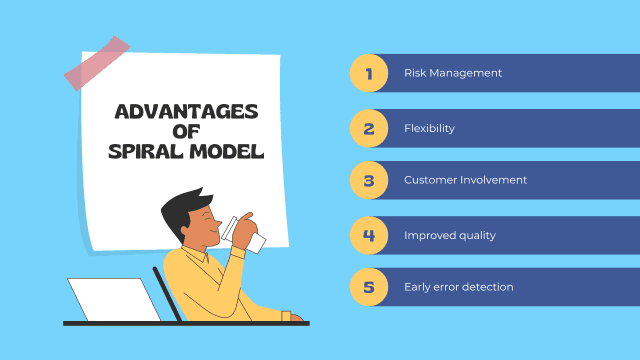 Advantages of the Spiral Model
1. Risk Management is Built In
You assess risks at every iteration. Problems get caught early when they're cheap to fix.
2. Flexibility
Requirements can change. Unlike Waterfall, you adapt as you go.
3. Stakeholder Engagement
Regular feedback loops keep everyone aligned. No surprises at the end.
4. Higher Quality
Multiple testing cycles mean fewer bugs in production.
5. Early Problem Detection
Issues surface in early spirals, not after launch.
6. Scales Well
Works for prototypes. Works for enterprise systems. Same framework.
7. Best of All Worlds
It's a meta-model. Use Waterfall, Agile, or prototyping elements as needed.
Disadvantages
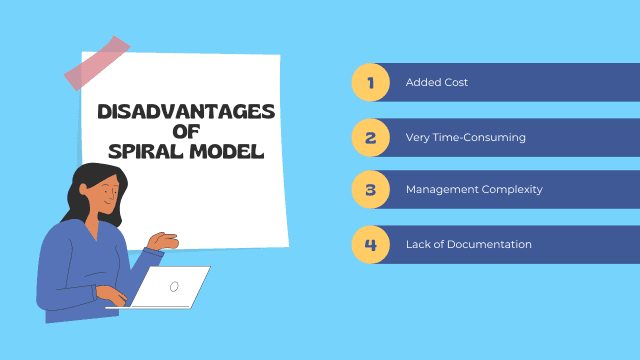 Disadvantages of the Spiral Model
1. Expensive
Risk analysis takes time and money. Not worth it for simple projects.
2. Requires Expertise
You need people who actually know risk management. Not every team has that.
3. Complex to Manage
Multiple iterations, formal phases, documentation. It's a lot to coordinate.
4. Overkill for Small Projects
If it's simple and low-risk, use something simpler.
5. Scope Creep Risk
Flexibility is a double-edged sword. Without boundaries, projects spiral forever.
6. Stakeholder Fatigue
Constant feedback demands can burn people out.
7. Unpredictable Timelines
Hard to say exactly when you'll be done. That frustrates some stakeholders.
Don't Use Spiral When:
- Project is small and simple
- Budget and scope are fixed
- Deadlines are immovable
- Team lacks risk management skills
- Organization prefers Agile or Waterfall
Triple Constraint in the Spiral Model
The Spiral Model's approach to managing the triple constraint (scope, time, and cost) differs fundamentally from traditional project management methodologies. It offers both advantages and challenges:
Scope Management:
- Adaptive Scope: The model's iterative nature allows for continuous scope refinement based on stakeholder feedback and changing requirements
- Incremental Delivery: Each spiral delivers working functionality, providing value even if the project scope evolves
- Risk-Driven Prioritization: Features are prioritized based on risk analysis, ensuring that high-risk elements are addressed early
Time Management:
- Flexible Timeline: While individual spirals have defined timelines, the overall project duration can adapt to changing circumstances
- Milestone-Based Progress: Regular evaluation phases provide clear progress indicators and decision points
- Risk Mitigation Impact: Time invested in risk analysis and mitigation typically reduces overall project duration by preventing major setbacks
Cost Management:
- Incremental Investment: Funding decisions can be made at each spiral iteration based on demonstrated value and progress
- Risk-Adjusted Budgeting: Costs are allocated based on risk analysis, focusing resources where they provide maximum value
- Early Termination Option: Projects can be terminated at any spiral boundary if business conditions change or risks become unmanageable
The Spiral Model recognizes that these constraints are interconnected. Optimizing one may require trade-offs in others. The model provides a framework for making these decisions systematically and transparently.
Why is the Spiral Model Called a Meta Model?
The Spiral Model earns its designation as a 'Meta Model' because it transcends traditional methodological boundaries. It incorporates and adapts elements from multiple software development approaches:
Multi-Methodology Integration:
- Waterfall Elements: Incorporates the systematic phases and thorough documentation of the Waterfall model
- Prototyping Practices: Utilizes prototyping as a risk mitigation strategy, particularly in early project phases
- Iterative Development: Adopts the cyclical nature of iterative models while adding formal risk assessment
- Incremental Delivery: Provides working software increments similar to Agile incremental development
Adaptive Framework:
- Methodology Selection: Teams can choose appropriate sub-methodologies for different spiral phases based on project needs
- Process Customization: The model adapts to organizational culture, project characteristics, and stakeholder preferences
- Risk-Driven Decisions: All methodological choices are informed by thorough risk analysis
Universal Applicability:
- Domain Independence: The model applies across different industry sectors and project types
- Scale Flexibility: Suitable for projects ranging from small prototypes to large enterprise systems
- Technology Agnostic: Works with various technologies and development platforms
This meta-model characteristic makes the Spiral Model particularly valuable. Organizations that need to manage diverse project portfolios with varying risk profiles and requirements find it especially useful.
Personal Experiences and Insights
In my experience working with various projects utilizing the Spiral Model, I found it particularly beneficial. It excels where requirements frequently evolve and risk management is paramount to project success.
Real-World Application Success:
The inherent flexibility of the Spiral Model allowed our teams to adapt swiftly to changing stakeholder expectations. We maintained rigorous risk management protocols that prevented potential pitfalls.
One particularly memorable case involved developing a financial trading platform. Regulatory requirements evolved significantly during development.
Key Success Factors:
- Stakeholder Engagement: The model's emphasis on regular stakeholder involvement ensured continuous alignment with business objectives
- Risk Mitigation: Early identification and systematic addressing of technical and business risks prevented major project setbacks
- Team Learning: Each spiral iteration provided opportunities for team learning and process improvement
- Quality Focus: The iterative testing and validation cycles resulted in significantly higher software quality
Lessons Learned:
The ongoing collaboration fostered by the model ensured alignment with client needs. It also created a culture of sustained improvement throughout the development process.
However, success with the Spiral Model requires strong project management capabilities. Stakeholder commitment to the iterative process is also essential.
Critical Implementation Insights:
- Early Investment: Time spent on thorough risk analysis in early spirals pays dividends throughout the project lifecycle
- Communication Clarity: Clear communication protocols are essential for managing the complex stakeholder interactions inherent in the model
- Tool Selection: Choosing appropriate tools for risk management, collaboration, and development significantly impacts project success
- Team Preparation: Teams need adequate training and preparation to effectively implement the model's risk-driven approach
Conclusion
The Spiral Model works when risk matters. NASA used it for the Space Shuttle. Financial institutions use it for trading platforms.
When to Use It:
- High failure costs
- Uncertain requirements
- Complex stakeholder environments
- Long-term projects with evolving needs
When to Skip It:
- Simple, low-risk projects
- Fixed budgets and timelines
- Teams without risk management experience
The Bottom Line:
It's not for everyone. But for high-stakes projects where getting it wrong is expensive, the Spiral Model provides a proven framework.
The upfront investment in risk analysis pays off when you catch problems early - when they're cheap to fix instead of catastrophic.
Quiz sobre Spiral Model
Sua pontuação: 0/18
Pergunta: Who introduced the Spiral Model and in what year?
Continue Reading
Software Development Life Cycle (SDLC) OverviewGet an overview of the Software Development Life Cycle (SDLC), and learn about the key phases and activities involved.
Waterfall Model in SDLCDiscover the ins and outs of the Waterfall model, a fundamental Software Development Life Cycle (SDLC) methodology. Learn its advantages and disadvantages.
Agile Methodology OverviewExplore the core values, principles, and practices of Agile methodology and learn how it can revolutionize your software development process.
Agile vs. Waterfall Methodology ComparisonDiscover the differences between Agile and Waterfall methodologies in project management, and learn how to choose the best approach for your projects.
DevOps in Software DevelopmentLearn about DevOps practices and how they integrate with modern software development methodologies for improved deployment and collaboration.
Effective Requirements Gathering: Techniques and TipsDiscover effective strategies for business analysts to master requirements gathering, ensuring projects are built on clear, actionable requirements.
Learn about Scrum and PSM-1 CertificationLearn about the PSM-1™ Certification for Scrum, its importance, and how to prepare for the exam to boost your Scrum Master career.
Mastering the Basics: An In-Depth Introduction to KanbanDive into the world of Kanban with this comprehensive introduction, covering its principles, benefits, and applications in various industries.
Frequently Asked Questions
Perguntas Frequentes (FAQs)
How does the Spiral Model differ from the Waterfall Model?
What are the limitations of the Spiral Model?
In which scenarios is the Spiral Model most effectively applied?
How does the Spiral Model facilitate effective communication among project stakeholders?
Can you provide an example of a project that successfully utilized the Spiral Model?
How does the Spiral Model compare to Scrum and other Agile methodologies?
What role does team psychology play in successful Spiral Model implementation?
How does organization size affect Spiral Model implementation?
How does the Spiral Model handle technical debt and DevOps integration?
What compliance and regulatory considerations apply to Spiral Model projects?
How does the Spiral Model accommodate global and culturally diverse teams?
What environmental and sustainability considerations relate to Spiral Model projects?
How does the Spiral Model integrate with performance management and career development?
What are the ROI and cost considerations for implementing the Spiral Model?
How does the Spiral Model support diversity, equity, and inclusion (DEI) initiatives?