
Von Abhay Talreja
3.8.2025
Mein neuester Artikel - Empirical Process Control - The Key to Agile Success
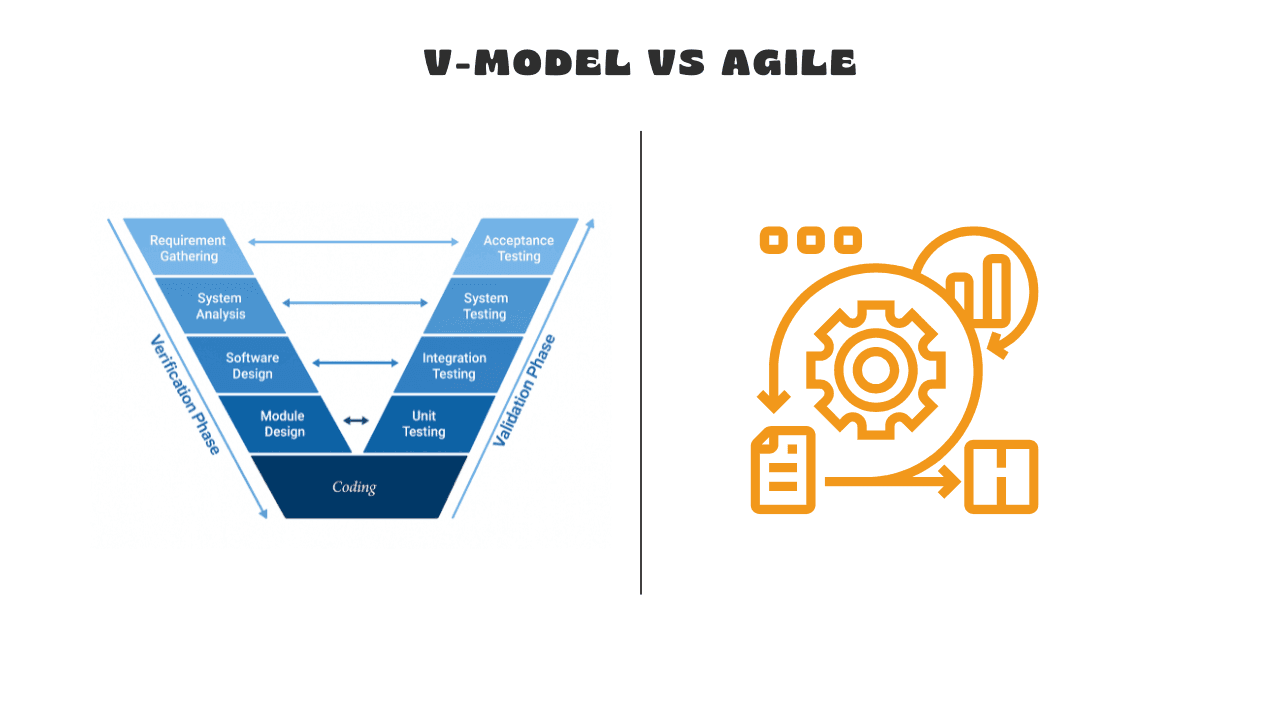 V-Model vs Agile Methodologies Comparison for Software Development Approaches
Quality assurance philosophy fundamentally separates V-Model from Agile methodologies.
The V-Model prioritizes systematic verification and validation through structured testing phases, while Agile methodologies emphasize working software delivery through iterative collaboration and rapid feedback.
These contrasting approaches serve different project contexts: regulated industries requiring comprehensive validation versus dynamic markets demanding rapid adaptation and customer responsiveness.
This detailed comparison provides selection criteria for choosing between verification-driven quality assurance and collaboration-driven iterative delivery based on regulatory requirements, quality criticality, and market dynamics.
The methodology choice significantly impacts development success: V-Model demonstrates high regulatory compliance success while Agile typically achieves faster time-to-market for non-regulated applications.
The V-Model and Agile methodologies represent fundamentally different approaches to software development, each optimized for different project contexts and organizational needs.
V-Model Approach:
Agile Philosophy:
| Aspect | V-Model | Agile Methodologies |
|---|---|---|
| Development Flow | Sequential phases with parallel testing | Iterative sprints with continuous feedback |
| Quality Integration | Built-in verification/validation phases | Continuous testing and quality practices |
| Planning Horizon | Comprehensive upfront planning | Emergent planning with regular adjustment |
| Change Management | Formal change control processes | Embracing change as competitive advantage |
| Delivery Pattern | Single delivery after complete validation | Regular incremental deliveries |
| Risk Approach | Systematic risk identification and mitigation | Iterative risk discovery and adaptation |
V-Model Quality Assurance:
The V-Model's systematic verification approach provides comprehensive quality assurance:
Quality Focus: V-Model projects typically achieve significantly fewer production defects and higher regulatory compliance success rates due to systematic verification processes.
Agile Quality Assurance:
Agile integrates quality through continuous practices and team collaboration:
Quality Trade-offs: While Agile achieves faster feedback and adaptation, V-Model provides more systematic quality assurance for safety-critical and regulated applications where defects have severe consequences.
V-Model Requirements:
Agile Requirements:
V-Model Team Structure:
Agile Team Structure:
The V-Model excels in environments requiring systematic verification, regulatory compliance, or where quality defects have severe consequences.
Regulatory and Compliance Environments:
Quality-Critical Applications:
An automotive manufacturer used V-Model for Advanced Driver Assistance System (ADAS) development:
Implementation Approach:
Results Achieved:
Choose Agile methodologies for:
Market-Responsive Applications:
Innovation and Research Projects:
An online retail company used Scrum for their e-commerce platform development:
Implementation Structure:
Business Results:
Select between V-Model and Agile methodologies based on systematic analysis of project characteristics, regulatory requirements, and organizational context.
Primary Decision Factors:
| Factor | V-Model Optimal | Agile Optimal |
|---|---|---|
| Regulatory Requirements | High compliance with formal validation | Low to moderate regulatory constraints |
| Quality Criticality | Safety-critical or life-critical systems | Business-critical with manageable defect impact |
| Requirements Stability | Well-defined, stable requirements | Evolving requirements with market uncertainty |
| Customer Involvement | Structured involvement at key milestones | Continuous collaboration and feedback |
| Risk Tolerance | Low tolerance for quality defects | Tolerance for iterative improvement |
| Documentation Needs | Comprehensive verification documentation | Minimal documentation emphasizing working software |
| Market Dynamics | Stable market with clear requirements | Dynamic market requiring rapid adaptation |
Step 1: Regulatory Assessment
Evaluate regulatory and compliance requirements:
Step 2: Quality Criticality Analysis
Assess the impact and cost of quality defects:
Step 3: Market and Customer Context
Analyze market dynamics and customer engagement:
Step 4: Organizational Capabilities
Evaluate team skills and organizational culture:
Choose V-Model if 3+ conditions apply:
Choose Agile if 3+ conditions apply:
Different industries favor V-Model or Agile based on regulatory requirements, quality criticality, and market dynamics.
V-Model Applications:
FDA-Regulated Medical Devices:
Implementation Approach: Systematic requirements analysis, design validation, clinical testing, and regulatory submission with complete verification documentation.
Agile Applications:
Healthcare IT and Digital Health:
V-Model for Regulatory and Risk Systems:
Trading and Risk Management:
Agile for Customer-Facing Systems:
Digital Banking and Customer Experience:
V-Model for Safety-Critical Systems:
Advanced Driver Assistance (ADAS):
Agile for Infotainment and User Experience:
Connected Vehicle Services:
V-Model for Infrastructure and Security:
Critical Infrastructure:
Agile for Applications and Services:
Customer-Facing Applications:
Addressing misunderstandings helps teams make informed decisions based on actual methodology characteristics rather than assumptions or stereotypes.
Myth 1: "V-Model is Waterfall with Extra Testing"
Reality: V-Model fundamentally changes the development approach through systematic verification:
Evidence: V-Model projects show fundamentally different defect discovery patterns, with significantly more defects found during development phases versus traditional approaches that discover most defects during testing phases.
Myth 2: "V-Model Cannot Work with Agile Practices"
Reality: V-Model can incorporate many Agile practices while maintaining systematic verification:
Hybrid Success: Organizations successfully combine V-Model verification with Agile practices for regulated software development.
Myth 3: "V-Model Requires Months of Testing Before Any Working Software"
Reality: V-Model produces working software throughout development with systematic validation:
Myth 4: "V-Model Teams Cannot Adapt to Changes"
Reality: V-Model handles changes through systematic impact analysis and traceability:
Myth 1: "Agile Doesn't Work for Regulated Industries"
Reality: Agile can work in regulated environments with appropriate adaptations:
Success Examples: FDA-regulated medical device companies successfully use Agile with appropriate compliance frameworks.
Myth 2: "Agile Sacrifices Quality for Speed"
Reality: Agile emphasizes quality through different mechanisms than traditional approaches:
Quality Data: Well-executed Agile projects achieve quality metrics comparable to or better than traditional approaches through different quality mechanisms.
Myth 3: "Agile Cannot Handle Complex, Large-Scale Systems"
Reality: Scaled Agile frameworks successfully address complex system development:
Success Evidence: Large technology companies, financial institutions, and government agencies successfully use scaled Agile for complex systems.
Combining V-Model verification with Agile collaboration optimizes benefits for complex projects requiring both systematic quality assurance and adaptive development.
Complex Project Characteristics:
Agile V-Model Approach:
Structure:
Implementation Process:
Component-Based Hybrid:
Risk-Based Selection:
Coordination Mechanisms:
A medical device company used hybrid approach for connected medical device platform:
Project Structure:
Implementation Results:
Key Success Factors:
Note on Performance Metrics: The comparative examples and case studies in this article are based on industry best practices and general project outcomes. Specific project results will vary based on team expertise, project complexity, organizational maturity, and implementation quality. Use these comparisons as guidance for methodology selection rather than performance guarantees.
Methodology selection should align with project context rather than organizational preferences or industry trends.
Choose V-Model for safety-critical, life-critical, or heavily regulated projects requiring systematic verification and validation with formal documentation.
Choose Agile methodologies for market-responsive, customer-facing, or innovation-driven projects requiring rapid iteration and continuous customer collaboration.
Use Hybrid approaches for complex systems with mixed requirements combining regulatory compliance with market responsiveness or customer collaboration needs.
The critical success factor is systematic analysis of project requirements including regulatory constraints, quality criticality, market dynamics, and customer involvement rather than methodology familiarity or current trends.
Quality-critical regulated projects benefit from V-Model's systematic verification, while dynamic customer-facing projects benefit from Agile's collaborative iteration and adaptation.
How do V-Model and Agile compare to DevOps practices for continuous deployment?
What are the cost implications of technical debt management between V-Model and Agile approaches?
How do V-Model and Agile methodologies handle remote and distributed team collaboration differently?
What are the implications for diversity, equity, and inclusion when choosing between V-Model and Agile?
How do V-Model and Agile approaches differ in handling cybersecurity and data privacy requirements?
What are the training and skill development differences between V-Model and Agile teams?
How do V-Model and Agile methodologies compare for startups versus established enterprises?
What are the environmental and sustainability considerations for V-Model versus Agile development?
How do V-Model and Agile approaches handle intellectual property and patent considerations?
What are the vendor and supplier management differences between V-Model and Agile projects?
How do V-Model and Agile methodologies compare for handling enterprise architecture and system integration?
What are the implications for performance optimization between V-Model and Agile approaches?
How do V-Model and Agile methodologies handle innovation management and research & development projects?
What are the change management and organizational transformation considerations for adopting V-Model versus Agile?
How do V-Model and Agile approaches compare for handling multi-generational technology migration projects?