
Von Abhay Talreja
5.8.2025
Mein neuester Artikel - Empirical Process Control - The Key to Agile Success
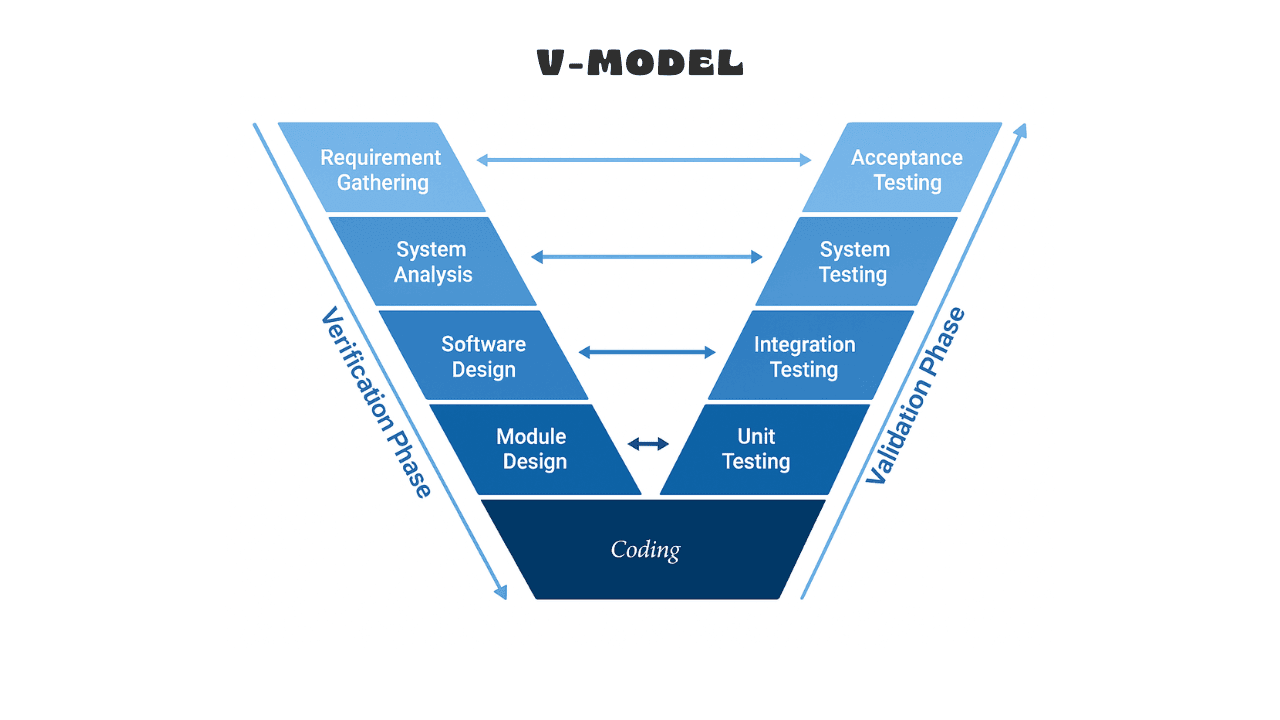 V-Model in Software Development: Complete Guide to Verification and Validation SDLC
The V-Model stands as one of the most systematic and quality-focused Software Development Life Cycle (SDLC) methodologies, placing verification and validation at the center of every development phase.
Unlike other SDLC approaches, the V-Model creates a direct correspondence between development phases and testing activities, ensuring that quality is built into the software from the ground up rather than tested in at the end.
This comprehensive guide explores advanced V-Model implementation strategies, regulatory compliance applications, and modern adaptations that integrate with Agile methodologies and DevOps practices.
Whether you're developing safety-critical systems, working in regulated industries, or simply committed to delivering the highest quality software, understanding the V-Model's verification and validation approach is essential for project success.
The V-Model represents a fundamental shift from traditional sequential development approaches by establishing a direct, traceable relationship between each development phase and its corresponding testing activity. This systematic approach ensures that verification ("Are we building the product right?") and validation ("Are we building the right product?") occur throughout the entire development lifecycle.
The V-Model operates on four foundational principles that distinguish it from other SDLC methodologies:
Early Test Planning: Test cases and acceptance criteria are defined during the corresponding development phase, not after code completion. This approach identifies potential issues before they become expensive problems.
Phase-Gate Quality Control: Each phase must meet specific quality criteria before progression to the next phase. This prevents defects from cascading through the development process.
Traceability Requirements: Every requirement must be traceable from initial specification through final validation, ensuring complete coverage and regulatory compliance.
Systematic Documentation: Comprehensive documentation at each phase supports regulatory audits, knowledge transfer, and long-term maintenance.
Verification vs. Validation: Verification ensures the product is built according to specifications (technical correctness), while validation ensures the product meets user needs and intended purpose (functional appropriateness).
The V-Model's distinctive "V" shape illustrates the relationship between development phases (left side) and testing phases (right side):
| Development Phase | Corresponding Test Phase | Primary Focus |
|---|---|---|
| Requirements Analysis | Acceptance Testing | User needs validation |
| System Design | System Testing | End-to-end functionality |
| Detailed Design | Integration Testing | Component interaction |
| Implementation | Unit Testing | Code-level verification |
The bottom of the "V" represents the implementation phase, where actual coding occurs. As development progresses up the right side, testing becomes increasingly comprehensive, ultimately validating that the complete system meets original requirements.
The V-Model's strength lies in its systematic correspondence between development and testing activities:
Requirements Correspondence: Each business requirement directly maps to acceptance test scenarios, ensuring complete validation coverage.
Design Correspondence: System and detailed design specifications drive comprehensive test planning for integration and system testing phases.
Implementation Correspondence: Code modules undergo immediate unit testing, with test cases derived from detailed design specifications.
This correspondence creates a robust quality framework that prevents requirements from being lost or misinterpreted during development.
Successful V-Model implementation requires careful planning, resource allocation, and adherence to systematic processes. The following phase-by-phase implementation guide provides practical strategies for maximizing V-Model effectiveness.
Duration: 15-25% of total project timeline Key Activities: Business requirements gathering, stakeholder analysis, acceptance criteria definition Deliverables: Requirements specification, acceptance test plan, traceability matrix foundation
Requirements Gathering Process:
Acceptance Test Planning:
Quality Gates:
Critical Success Factor: Invest adequate time in requirements analysis. Studies show that fixing a requirement defect in production costs 100-200 times more than fixing it during requirements phase.
Duration: 20-30% of total project timeline Key Activities: High-level system architecture, interface design, system test strategy Deliverables: System architecture document, interface specifications, system test plan
System Architecture Development:
System Test Planning:
Integration Planning:
Duration: 15-20% of total project timeline Key Activities: Component design, database design, integration test specification Deliverables: Detailed design documents, database schema, integration test plan
Component Design:
Integration Test Planning:
Duration: 25-35% of total project timeline Key Activities: Code development, unit test creation, code review Deliverables: Source code, unit test suites, code coverage reports
Development Best Practices:
Unit Testing Strategy:
Quality Assurance:
Duration: 10-15% of total project timeline Key Activities: Component integration, interface testing, integration defect resolution Deliverables: Integration test results, interface validation reports, integrated system
Integration Approaches:
| Approach | Description | Best for | Challenges |
|---|---|---|---|
| Big Bang | Integrate all components simultaneously | Small systems | Difficult defect isolation |
| Top-down | Start with top-level modules | UI-heavy applications | Requires extensive stubs |
| Bottom-up | Start with low-level modules | Data-processing systems | Requires test drivers |
| Sandwich | Combine top-down and bottom-up | Complex systems | Resource intensive |
Integration Test Execution:
Duration: 15-20% of total project timeline Key Activities: End-to-end testing, performance testing, security testing Deliverables: System test results, performance reports, security assessment
System Test Categories:
Functional Testing:
Non-Functional Testing:
Environmental Testing:
Duration: 10-15% of total project timeline Key Activities: User acceptance testing, business validation, production readiness Deliverables: UAT results, business sign-off, production deployment approval
Acceptance Testing Types:
User Acceptance Testing (UAT):
Business Acceptance Testing (BAT):
Operational Acceptance Testing (OAT):
The V-Model excels in specific project contexts where quality, traceability, and systematic validation are paramount. Understanding when to apply the V-Model ensures optimal project outcomes and resource utilization.
The V-Model is most effective for projects with the following characteristics:
Well-Defined Requirements: Projects with stable, clearly articulated requirements that are unlikely to change significantly during development.
Quality-Critical Applications: Systems where failure could result in safety risks, financial losses, or regulatory violations.
Regulatory Compliance Needs: Projects requiring comprehensive documentation and traceability for regulatory audits and certifications.
Complex Integration Requirements: Systems with multiple internal and external integration points requiring systematic validation.
Experienced Development Teams: Teams with strong testing expertise and familiarity with systematic development processes.
The V-Model has proven particularly effective in the following industries:
Healthcare and Medical Devices:
Automotive Industry:
Aerospace and Defense:
Financial Services:
Telecommunications:
Use this decision matrix to evaluate V-Model suitability for your project:
| Factor | V-Model Favors | Alternative Approaches |
|---|---|---|
| Requirements Stability | Stable, well-defined | Agile for evolving requirements |
| Quality Criticality | Safety/mission-critical | Spiral for high-risk projects |
| Regulatory Environment | Highly regulated | Waterfall for simple compliance |
| Team Experience | Testing-experienced | Agile for learning teams |
| Project Size | Medium to large | Kanban for small projects |
| Timeline Constraints | Adequate time for testing | Iterative for time-pressured projects |
Decision Tip: If 4 or more factors favor the V-Model, it's likely the optimal choice. For mixed results, consider hybrid approaches combining V-Model principles with other methodologies.
The V-Model's systematic verification and validation approach distinguishes it from other SDLC methodologies. Understanding these differences helps teams select the optimal methodology for their project requirements.
V-Model Methodology Comparisons:
V-Model vs Waterfall Model: Compare verification-driven testing with documentation-driven sequential development for quality-critical projects.
V-Model vs Agile Methodologies: Analyze systematic validation versus collaborative iteration for regulatory compliance and customer-responsive development.
V-Model vs Iterative Model: Examine comprehensive verification versus incremental delivery for risk management and quality assurance.
Each comparison provides detailed analysis, implementation guidance, and decision frameworks to help you choose the most appropriate methodology for your specific project context, regulatory requirements, and quality objectives.
The V-Model's systematic approach and comprehensive documentation make it particularly well-suited for regulated industries. Understanding specific regulatory requirements ensures successful compliance and audit readiness.
The FDA's Quality System Regulation (QSR) and software guidance documents align closely with V-Model principles:
Design Controls (21 CFR 820.30):
Software Documentation Requirements:
V-Model FDA Compliance Implementation:
| V-Model Phase | FDA Requirement | Key Deliverables |
|---|---|---|
| Requirements Analysis | Design Inputs | Software requirements specification |
| System Design | Design Outputs | System architecture document |
| Detailed Design | Design Outputs | Detailed design specification |
| Implementation | Design Outputs | Source code and unit tests |
| Integration Testing | Design Verification | Integration test reports |
| System Testing | Design Verification | System test reports |
| Acceptance Testing | Design Validation | User acceptance test results |
ISO 26262 (Functional Safety for Road Vehicles) mandates systematic development processes that align with V-Model structure:
Safety Lifecycle Integration:
Automotive Safety Integrity Levels (ASIL):
V-Model ASIL Implementation Strategy:
| ASIL Level | V-Model Enhancement | Additional Activities |
|---|---|---|
| ASIL A | Standard V-Model | Basic safety analysis |
| ASIL B | Enhanced reviews | Independent safety assessment |
| ASIL C | Formal verification | Diverse redundancy analysis |
| ASIL D | Maximum rigor | Independent development teams |
DO-178C (Software Considerations in Airborne Systems) and similar defense standards require systematic verification and validation:
Software Level Requirements:
V-Model DO-178C Alignment:
Modern V-Model implementations incorporate advanced strategies that enhance effectiveness while maintaining systematic rigor. These strategies address contemporary challenges in software development and testing.
Risk-based testing prioritizes test activities based on risk assessment, optimizing resource allocation and maximizing defect detection:
Risk Assessment Framework:
| Risk Factor | Impact Assessment | Probability Assessment | Test Priority |
|---|---|---|---|
| Safety-critical functions | High impact | Medium probability | Critical |
| Complex algorithms | Medium impact | High probability | High |
| Third-party integrations | Medium impact | Medium probability | Medium |
| Administrative functions | Low impact | Low probability | Low |
Risk-Based Test Strategy Implementation:
Risk Mitigation Through V-Model Phases:
Comprehensive traceability ensures complete requirement coverage and supports regulatory compliance:
Traceability Relationships:
Business Requirements → System Requirements → Design Elements → Code Components → Test Cases → Test ResultsTraceability Matrix Structure:
| Requirement ID | System Design | Detailed Design | Code Module | Unit Test | Integration Test | System Test | Acceptance Test |
|---|---|---|---|---|---|---|---|
| REQ-001 | SYS-001 | DET-001, DET-002 | MOD-001 | UT-001 | IT-001 | ST-001 | AT-001 |
| REQ-002 | SYS-002 | DET-003 | MOD-002 | UT-002 | IT-002 | ST-002 | AT-002 |
Automated Traceability Tools:
Integrating Test-Driven Development (TDD) principles with V-Model structure enhances code quality and reduces defects:
TDD Integration Strategy:
TDD Benefits in V-Model Context:
TDD Implementation Timeline:
| V-Model Phase | TDD Activity | Deliverable |
|---|---|---|
| Requirements Analysis | Define acceptance test criteria | Acceptance test scenarios |
| System Design | Create system test specifications | System test cases |
| Detailed Design | Develop integration test cases | Integration test specifications |
| Implementation | Write unit tests before coding | Unit test suites |
Contemporary software development environments require V-Model adaptations that maintain systematic rigor while embracing modern practices and technologies.
Hybrid approaches combine V-Model's systematic quality assurance with Agile's flexibility and responsiveness:
Agile V-Model (AV-Model) Implementation:
Sprint-Based V-Model Execution:
| V-Model Phase | Sprint Duration | Sprint Activities | Sprint Deliverables |
|---|---|---|---|
| Requirements Analysis | 2-3 sprints | User story creation, acceptance criteria | Product backlog, acceptance tests |
| System Design | 3-4 sprints | Architecture design, system planning | System design, test strategy |
| Detailed Design | 2-3 sprints | Component design, test planning | Detailed specs, test cases |
| Implementation | 4-6 sprints | Code development, unit testing | Working software, unit tests |
Benefits of Hybrid Approach:
Integrating DevOps practices with V-Model enhances automation, accelerates feedback, and improves deployment reliability:
Continuous Integration (CI) in V-Model:
Continuous Deployment (CD) Considerations:
Infrastructure as Code (IaC):
DevOps Tool Integration:
| V-Model Phase | DevOps Tools | Integration Purpose |
|---|---|---|
| Requirements | JIRA, Azure DevOps | Requirement tracking and traceability |
| Design | Confluence, SharePoint | Design documentation and collaboration |
| Implementation | Git, Jenkins, SonarQube | Code versioning, CI/CD, quality analysis |
| Testing | Selenium, TestRail | Test automation and management |
| Deployment | Docker, Kubernetes | Containerization and orchestration |
| Monitoring | Prometheus, Grafana | Performance monitoring and alerting |
CI/CD practices enhance V-Model effectiveness by providing rapid feedback and automated quality assurance:
CI Pipeline Design for V-Model:
Code Commit → Static Analysis → Unit Tests → Integration Tests → Security Scan → Build Artifact → DeploymentAutomated Testing Strategy:
Quality Gates in CI Pipeline:
Selecting appropriate tools and technologies is crucial for successful V-Model implementation. Modern tool ecosystems support comprehensive lifecycle management, from requirements through deployment.
Effective requirements management forms the foundation of successful V-Model implementation:
Enterprise Requirements Platforms:
| Tool | Strengths | Best for | Integration Capabilities |
|---|---|---|---|
| IBM DOORS | Comprehensive traceability | Large regulated projects | Strong ALM integration |
| Polarion | Web-based collaboration | Distributed teams | DevOps tool integration |
| Jama Connect | User-friendly interface | Cross-functional teams | Test management tools |
| Azure DevOps | Microsoft ecosystem | Agile-V-Model hybrids | Complete DevOps pipeline |
Requirements Management Features:
Comprehensive test management supports V-Model's systematic testing approach:
Test Management Solutions:
| Platform | Key Features | Integration Strength | Regulatory Support |
|---|---|---|---|
| TestRail | User-friendly test case management | Wide tool integration | Audit trail and reporting |
| Zephyr | Jira-native testing | Atlassian ecosystem | Compliance reporting |
| qTest | Enterprise test management | DevOps pipeline integration | Regulatory traceability |
| PractiTest | End-to-end test management | Third-party tool connectivity | Comprehensive documentation |
Essential Test Management Capabilities:
Traceability tools ensure comprehensive requirement coverage and support regulatory compliance:
Traceability Solutions:
| Tool Category | Examples | Primary Function | V-Model Benefit |
|---|---|---|---|
| ALM Platforms | Polarion, Jama | End-to-end lifecycle | Complete traceability |
| Requirements Tools | DOORS, Caliber | Requirement management | Requirements traceability |
| Test Management | TestRail, qTest | Test case management | Test traceability |
| Code Analysis | SonarQube, Veracode | Code quality analysis | Code-to-requirement linking |
Automated Traceability Features:
Compliance Reporting Capabilities:
Successful V-Model implementation requires addressing common challenges that can derail projects or reduce methodology effectiveness.
The V-Model's comprehensive documentation requirements can become burdensome without proper management:
Documentation Challenges:
Documentation Management Strategies:
| Strategy | Implementation | Benefits | Tools |
|---|---|---|---|
| Living Documentation | Auto-generate from code and tests | Always current | Sphinx, GitBook |
| Tiered Documentation | Different detail levels for different audiences | Appropriate depth | Confluence, SharePoint |
| Template Standardization | Consistent document structure | Reduced creation effort | Corporate templates |
| Collaborative Authoring | Multiple contributors per document | Shared ownership | Google Docs, Notion |
Documentation Optimization Techniques:
V-Model projects require careful timeline and resource planning to avoid delays and cost overruns:
Common Timeline Challenges:
Resource Management Best Practices:
| Resource Type | Planning Consideration | Allocation Strategy | Success Metrics |
|---|---|---|---|
| Testing Resources | 30-40% of total effort | Parallel test planning and execution | Test coverage percentage |
| Documentation | 15-20% of development effort | Concurrent with development | Documentation completeness |
| Review and QA | 10-15% of phase effort | Built into each phase | Review effectiveness metrics |
| Training | 5-10% of project effort | Front-loaded training | Team capability assessment |
Timeline Optimization Strategies:
V-Model success depends on appropriate team structure and skill development:
Required Skill Sets:
| Role | Technical Skills | Process Skills | V-Model Specific |
|---|---|---|---|
| Business Analyst | Requirements analysis | Stakeholder management | Acceptance criteria definition |
| System Architect | System design | Integration planning | Test strategy development |
| Developer | Programming languages | Code quality practices | Unit testing expertise |
| Test Engineer | Testing frameworks | Test case design | Verification and validation |
| Quality Assurance | Quality standards | Process improvement | Traceability management |
Team Structure Considerations:
Skill Development Programs:
Effective measurement and metrics provide insights into V-Model implementation success and areas for improvement.
Quality metrics demonstrate V-Model effectiveness in delivering high-quality software:
Defect-Related Metrics:
| Metric | Target Range | Calculation | Interpretation |
|---|---|---|---|
| Defect Detection Rate | Over 80% pre-production | (Pre-prod defects / Total defects) × 100 | Higher is better |
| Phase Defect Removal | Over 90% per phase | (Phase defects fixed / Phase defects found) × 100 | Process effectiveness |
| Defect Escape Rate | Under 5% to production | (Production defects / Total defects) × 100 | Lower is better |
| Mean Time to Resolution | Under 2 days critical | Average time from detection to resolution | Process efficiency |
Test Coverage Metrics:
Quality Achievement Indicators:
Process metrics evaluate V-Model implementation efficiency and identify optimization opportunities:
Phase Efficiency Metrics:
| Phase | Efficiency Indicator | Target | Measurement Method |
|---|---|---|---|
| Requirements | Requirement stability | Under 10% change rate | Change request analysis |
| Design | Design review effectiveness | Over 95% issue detection | Review outcome tracking |
| Implementation | Code quality score | Over 8.0/10 | Static analysis results |
| Testing | Test execution efficiency | Over 90% automation | Automated vs manual ratio |
Resource Utilization Metrics:
Timeline Performance Indicators:
Compliance metrics ensure regulatory requirements are met and audit readiness is maintained:
Compliance Metrics:
| Compliance Area | Metric | Target | Evidence |
|---|---|---|---|
| Traceability | Requirement coverage | 100% | Traceability matrix |
| Documentation | Document completeness | Over 95% | Document checklist |
| Process Adherence | Phase gate compliance | 100% | Gate review records |
| Risk Management | Risk mitigation rate | Over 90% | Risk register updates |
Audit Readiness Indicators:
Regulatory Compliance Tracking:
The V-Model continues evolving to address emerging technologies and development practices while maintaining its core verification and validation principles.
Artificial Intelligence and Machine Learning are transforming V-Model testing practices:
AI Testing Applications:
Machine Learning Integration:
AI-Powered Quality Assurance:
Model-based testing approaches enhance V-Model systematic validation:
Model-Based Testing Benefits:
Implementation Strategies:
Tools and Technologies:
Digital twins provide virtual replicas for comprehensive system validation:
Digital Twin Applications in V-Model:
Implementation Considerations:
Industry Applications:
The V-Model remains a powerful and relevant methodology for quality-driven software development, particularly in regulated industries and safety-critical applications. Its systematic approach to verification and validation provides a robust framework for delivering high-quality software that meets stringent requirements and compliance standards.
Key takeaways from this comprehensive guide:
V-Model Strengths:
Implementation Success Factors:
Modern Adaptations:
Next Steps for Implementation:
The V-Model's emphasis on quality, traceability, and systematic validation continues to provide value in an increasingly complex software development landscape. By understanding its principles, implementation strategies, and modern adaptations, teams can leverage the V-Model's strengths while addressing contemporary development challenges.
Whether you're developing medical devices, automotive systems, financial platforms, or any quality-critical software, the V-Model provides a proven framework for systematic verification and validation that ensures your software meets the highest standards of quality and reliability.
How does the V-Model compare to Test-Driven Development (TDD) in terms of testing approach?
What team psychology and change management considerations are important for V-Model success?
How does organization size affect V-Model implementation effectiveness?
What are the cost implications and ROI considerations for implementing the V-Model?
How does the V-Model handle technical debt management compared to Agile approaches?
What compliance and regulatory advantages does the V-Model provide over other methodologies?
How does the V-Model accommodate global and distributed development teams?
What environmental and sustainability considerations relate to V-Model software development?
How does the V-Model integrate with performance management and professional development?
How does the V-Model support diversity, equity, and inclusion (DEI) initiatives in software development?
What cybersecurity considerations are specific to V-Model implementation?
How does the V-Model handle innovation projects versus production maintenance work?
What data privacy and GDPR considerations apply to V-Model software development?
How does V-Model implementation vary across different industry sectors?
What are the long-term maintenance and evolution challenges specific to V-Model projects?