
Von Abhay Talreja
7.8.2025
Mein neuester Artikel - Empirical Process Control - The Key to Agile Success
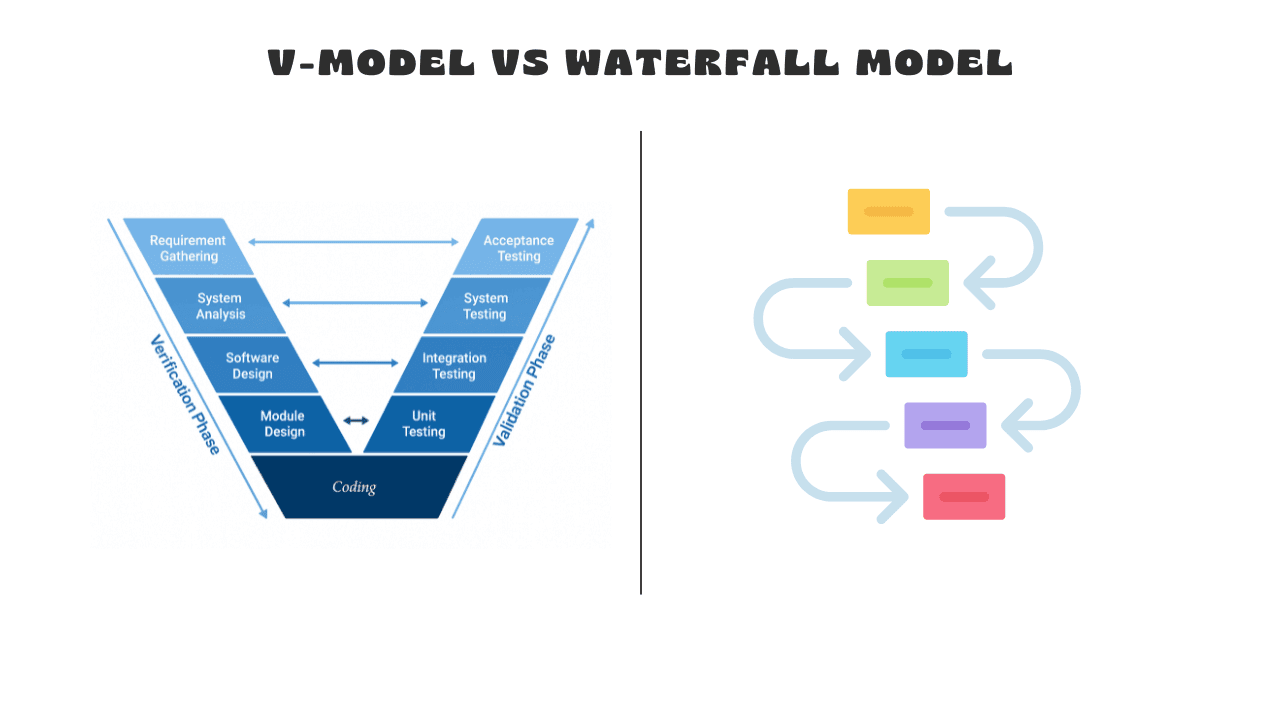 V-Model vs Waterfall Model Comparison for Software Development Quality Assurance
Quality assurance strategy fundamentally differentiates V-Model from Waterfall methodology.
The V-Model emphasizes verification and validation at every development stage, while the Waterfall Model focuses on comprehensive documentation with testing at the end.
Understanding these quality-driven differences impacts project success in regulated industries like healthcare, automotive, and financial services where early defect detection prevents costly compliance failures.
This comprehensive analysis provides a decision framework for selecting between verification-driven and documentation-driven approaches based on quality requirements, regulatory constraints, and testing integration needs.
Choosing the optimal methodology can significantly reduce defect rates and improve regulatory compliance success rates for quality-critical applications.
The V-Model and Waterfall Model share sequential development patterns but differ fundamentally in quality assurance strategy and testing integration approaches.
V-Model Characteristics:
Waterfall Model Characteristics:
| Aspect | V-Model | Waterfall Model |
|---|---|---|
| Testing Integration | Parallel to development phases | Sequential after development |
| Quality Gates | Built-in at every phase | Primary gate at testing phase |
| Defect Detection | Early in corresponding test phases | Late in testing phase |
| Phase Validation | Development plus testing criteria | Development deliverable criteria |
| Quality Assurance | Continuous verification/validation | Comprehensive end-phase testing |
| Documentation | Moderate with test specifications | Extensive with detailed processes |
V-Model Testing Integration:
The V-Model's defining characteristic is systematic testing integration:
Waterfall Testing Strategy:
Waterfall approaches testing as a distinct sequential phase:
V-Model Quality Assurance:
Quality Impact: V-Model projects typically achieve significantly fewer production defects compared to Waterfall projects of similar complexity, primarily due to early defect detection and continuous validation processes.
Waterfall Quality Assurance:
V-Model Documentation:
Waterfall Documentation:
The V-Model excels when quality assurance and early defect detection are critical project success factors.
Quality-Critical Applications:
Regulatory Compliance Projects:
Testing-Intensive Projects:
A cardiac monitoring device manufacturer used V-Model for FDA-regulated software:
Implementation Approach:
Results Achieved:
Choose Waterfall for:
Well-Defined Requirements:
Process-Driven Organizations:
A state government used Waterfall for tax system modernization:
Implementation Phases:
Outcomes:
Use this systematic approach to select between V-Model and Waterfall based on project characteristics and organizational needs.
Primary Assessment Factors:
| Factor | V-Model Optimal | Waterfall Optimal |
|---|---|---|
| Quality Requirements | High, with early defect detection | Standard, with end-phase testing |
| Regulatory Complexity | Moderate to high with testing focus | High with documentation focus |
| Testing Criticality | Critical throughout development | Important but end-phase focused |
| Requirements Stability | Moderate stability acceptable | High stability required |
| Defect Cost Impact | High cost of production defects | Moderate defect impact |
| Testing Expertise | Team has strong testing skills | Limited testing expertise |
| Documentation Emphasis | Moderate with testing focus | Extensive documentation required |
Choose V-Model if 4+ conditions apply:
Choose Waterfall if 4+ conditions apply:
Healthcare and Medical Devices:
Automotive Industry:
Financial Services:
Government and Public Sector:
Different industries leverage V-Model and Waterfall based on regulatory requirements, quality criticality, and organizational culture.
V-Model Applications:
Medical Device Software Development:
Digital Health Applications:
Waterfall Applications:
Hospital Information Systems:
V-Model for Safety-Critical Systems:
ISO 26262 Compliance:
Example: Adaptive Cruise Control System:
Waterfall for Non-Safety Systems:
Infotainment Systems:
V-Model for Trading and Risk Systems:
High-Frequency Trading Platforms:
Waterfall for Regulatory Reporting:
Compliance Reporting Systems:
V-Model for Citizen Services:
Digital Government Platforms:
Waterfall for Administrative Systems:
Document Management Systems:
Addressing widespread misunderstandings helps teams make informed decisions based on actual methodology characteristics rather than assumptions.
Myth 1: "V-Model is Just Waterfall with More Testing"
Reality: V-Model fundamentally changes the development approach:
Evidence: Projects using V-Model typically show significantly fewer production defects compared to Waterfall projects, demonstrating fundamental process differences.
Myth 2: "V-Model Requires Specialized Testing Expertise"
Reality: V-Model testing skills are developable and transferable:
Myth 3: "V-Model Always Costs More Than Waterfall"
Reality: V-Model often reduces total project costs:
Cost Analysis: V-Model projects often achieve lower total cost of ownership for quality-critical applications due to reduced post-deployment support costs.
Myth 4: "V-Model is Inflexible and Cannot Handle Changes"
Reality: V-Model handles changes through systematic impact analysis:
Myth 1: "Waterfall is Obsolete and Should Never be Used"
Reality: Waterfall remains optimal for specific scenarios:
Current Usage: A significant portion of enterprise projects continue to successfully use Waterfall or Waterfall-hybrid approaches for appropriate project types.
Myth 2: "Waterfall Cannot Deliver Quality Software"
Reality: Waterfall can deliver high-quality software through different mechanisms:
Quality Evidence: Well-executed Waterfall projects achieve quality metrics comparable to other methodologies for appropriate project types.
Myth 3: "Waterfall Cannot Handle Complex Projects"
Reality: Waterfall has successfully delivered complex systems:
Success Examples: NASA missions, air traffic control systems, banking core systems, and major ERP implementations.
Combining V-Model and Waterfall approaches optimizes benefits for projects with mixed characteristics requiring both systematic quality assurance and comprehensive documentation.
Mixed Project Characteristics:
Sequential Hybrid Approach:
Phase-Based Selection:
Benefits:
Component-Based Hybrid:
Risk-Driven Selection:
Coordination Mechanisms:
A regional bank used hybrid approach for core banking system modernization:
Project Structure:
Implementation Results:
Lessons Learned:
Note on Performance Metrics: The comparative examples and case studies in this article are based on industry best practices and general project outcomes. Specific project results will vary based on team expertise, project complexity, organizational maturity, and implementation quality. Use these comparisons as guidance for methodology selection rather than performance guarantees.
Methodology selection should prioritize quality assurance strategy alignment with project requirements rather than organizational preferences or industry trends.
Choose V-Model for quality-critical projects requiring early defect detection, systematic verification and validation, or regulatory compliance with testing emphasis.
Choose Waterfall for projects with stable requirements, extensive documentation needs, or organizational processes favoring comprehensive upfront planning.
Use Hybrid approaches when projects have mixed characteristics requiring both systematic quality assurance and comprehensive documentation.
The key success factor is systematic methodology selection based on quality requirements, regulatory constraints, testing criticality, and organizational capabilities rather than methodology familiarity or current trends.
Quality-driven projects benefit most from V-Model's integrated testing approach, while process-driven projects benefit from Waterfall's comprehensive documentation strategy.
How do V-Model and Waterfall compare to Agile methodologies for team collaboration?
What are the training requirements for teams transitioning from Waterfall to V-Model?
How do V-Model and Waterfall handle technical debt differently?
What are the cybersecurity implications of choosing V-Model versus Waterfall for sensitive applications?
How do project management tools differ between V-Model and Waterfall implementations?
What are the scalability considerations for V-Model versus Waterfall in large enterprise environments?
How do V-Model and Waterfall compare for distributed team management across different time zones?
What are the environmental and sustainability impacts of choosing V-Model versus Waterfall?
How do V-Model and Waterfall integrate with DevOps and continuous deployment practices?
What are the cost implications of quality assurance testing for V-Model versus Waterfall over a 5-year period?
How do V-Model and Waterfall support compliance with data privacy regulations like GDPR?
What are the career development implications for software professionals specializing in V-Model versus Waterfall?
How do V-Model and Waterfall handle innovation and research & development projects differently?
What are the vendor management considerations when outsourcing projects using V-Model versus Waterfall?
How do V-Model and Waterfall compare for supporting diversity, equity, and inclusion in software development teams?