
Von Abhay Talreja
1.8.2025
Mein neuester Artikel - Empirical Process Control - The Key to Agile Success
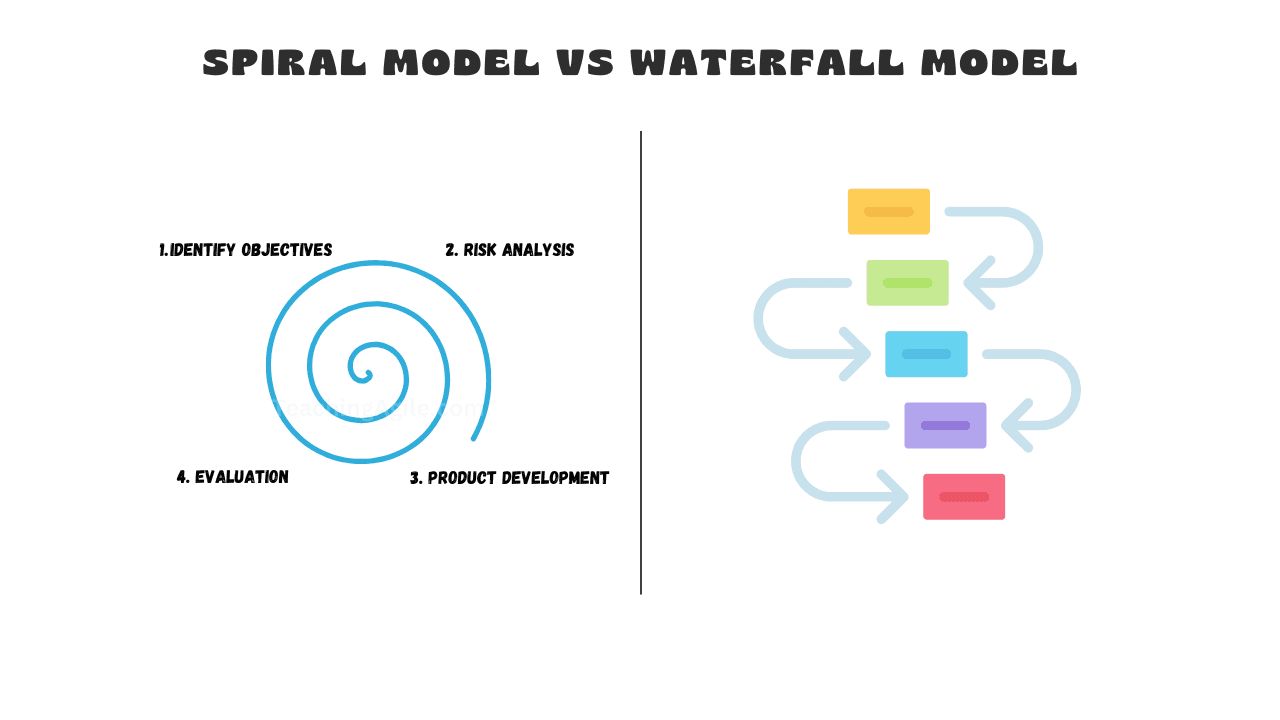 Spiral Model vs Waterfall Model Comparison for Software Development Projects
Choosing between Spiral and Waterfall models can make or break your software development project.
The Spiral Model excels with high-risk, evolving requirements, while the Waterfall Model delivers predictability for well-defined projects.
Unlike Agile methodologies that prioritize working software, or pure Iterative models that focus on incremental delivery, these two approaches offer distinct advantages for specific project contexts.
This guide provides a practical framework for selecting the optimal methodology based on your project's risk profile, requirement stability, and organizational constraints.
Making the right choice can significantly improve project success rates and prevent costly methodology mismatches that lead to budget overruns and timeline delays.
The Spiral Model and Waterfall Model represent fundamentally different approaches to software development. Understanding their core characteristics is essential for making informed methodology choices.
Spiral Model:
Waterfall Model:
| Aspect | Spiral Model | Waterfall Model |
|---|---|---|
| Progression | Iterative cycles (3-6 spirals) | Sequential phases |
| Feedback | Continuous throughout development | Primarily at phase boundaries |
| Deliverables | Working software each iteration | Complete system at end |
| Flexibility | High adaptability to change | Low flexibility once started |
| Risk Management | Continuous assessment | Upfront identification |
| Timeline | Variable iteration lengths | Fixed phase durations |
Spiral Model Risk Management:
The Spiral Model's risk-driven approach provides systematic risk management:
Waterfall Model Risk Management:
Waterfall addresses risks through comprehensive upfront planning:
Spiral Model Requirements:
Waterfall Model Requirements:
Spiral Model Characteristics:
| Factor | Approach | Benefits | Challenges |
|---|---|---|---|
| Budget | Incremental funding | Early ROI, risk mitigation | Uncertainty in total cost |
| Timeline | Flexible iterations | Market responsiveness | Variable project duration |
| Resource | Variable allocation | Optimized for spiral needs | Complex resource planning |
Waterfall Model Characteristics:
| Factor | Approach | Benefits | Challenges |
|---|---|---|---|
| Budget | Fixed upfront allocation | Predictable costs | Limited flexibility |
| Timeline | Sequential phases | Accurate predictions | Rigid deadlines |
| Resource | Phase-specific teams | Specialized efficiency | Resource transitions |
The Spiral Model excels when projects involve significant uncertainty, risk, or innovation requirements.
High-Risk Environments:
Evolving Requirements:
Example Success: E-commerce Platform
A retail company used Spiral for their e-commerce platform:
Choose Waterfall for:
Example: Government tax system delivered on-time with 100% regulatory compliance.
Combining both methodologies can optimize results for complex projects with mixed characteristics.
Mixed Project Characteristics:
Sequential Hybrid:
Parallel Hybrid:
Example: Government Portal
A federal agency used hybrid approach for citizen services:
Use this systematic approach to select the optimal methodology for your project.
Primary Assessment Factors:
| Factor | Spiral Favors | Waterfall Favors |
|---|---|---|
| Risk Level | High technical/business risk | Low, well-understood risks |
| Requirements | Evolving, uncertain | Stable, well-defined |
| Stakeholder Availability | High engagement possible | Limited, scheduled involvement |
| Timeline Flexibility | Flexible, market-driven | Fixed deadlines |
| Budget | Incremental funding | Fixed budget allocation |
| Innovation Level | High innovation/R&D | Established technology |
| Regulatory Compliance | Moderate requirements | Strict compliance needs |
Choose Spiral Model if 3+ conditions are true:
Choose Waterfall Model if 3+ conditions are true:
| Project Type | Spiral Model Strength | Waterfall Model Strength |
|---|---|---|
| High-Risk, Complex | High effectiveness | Lower effectiveness |
| Stable Requirements | Moderate effectiveness | High effectiveness |
| Regulatory Projects | Good effectiveness | High effectiveness |
| Innovation Projects | High effectiveness | Lower effectiveness |
| Fixed-Scope Contracts | Moderate effectiveness | High effectiveness |
Different industries favor specific methodologies based on regulatory requirements and risk profiles.
Waterfall for Regulatory Systems:
Spiral for Innovation:
Waterfall for Compliance:
Spiral for Market-Facing:
Waterfall for Control Systems:
Spiral for Digital Transformation:
Clearing up widespread misunderstandings about both methodologies helps teams make better-informed decisions based on actual methodology characteristics rather than myths.
Myth 1: "Spiral Model is Just Agile with More Documentation"
Reality: While both are iterative, the Spiral Model differs fundamentally from Agile:
Myth 2: "Spiral Model Always Takes Longer and Costs More"
Reality: Spiral can actually reduce time and cost for appropriate projects:
Project Experience: Spiral projects with high uncertainty often achieve better cost performance than Waterfall for similar complexity projects due to early risk mitigation and stakeholder feedback.
Myth 3: "Spiral Model is Too Complex for Small Projects"
Reality: Spiral complexity scales with project needs:
Myth 4: "Spiral Model Requires Specialized Risk Management Expertise"
Reality: Risk management skills can be developed and shared:
Myth 1: "Waterfall is Outdated and Should Never be Used"
Reality: Waterfall remains optimal for specific project types:
Current Usage: A significant portion of enterprise projects continue to use Waterfall or Waterfall-hybrid approaches successfully for appropriate project types.
Myth 2: "Waterfall Doesn't Allow Any Changes"
Reality: Waterfall includes formal change management processes:
Myth 3: "Waterfall Always Delivers Poor Quality"
Reality: Waterfall's structured approach can deliver high quality:
Quality Data: Well-executed Waterfall projects achieve defect rates comparable to other methodologies for appropriate project types.
Myth 4: "Waterfall Teams are Less Collaborative"
Reality: Waterfall involves significant collaboration within appropriate structures:
Myth 5: "Waterfall Cannot Handle Complex Projects"
Reality: Waterfall has successfully delivered many complex systems:
Examples: NASA space missions, air traffic control systems, and major ERP implementations demonstrate Waterfall's capability for complex projects.
Note on Performance Metrics: The comparative examples and case studies in this article are based on industry best practices and general project outcomes. Specific project results will vary based on team expertise, project complexity, organizational maturity, and implementation quality. Use these comparisons as guidance for methodology selection rather than performance guarantees.
Success depends on aligning methodology characteristics with specific project contexts rather than organizational preferences.
Choose Spiral for high-risk, uncertain, or innovative projects requiring continuous stakeholder engagement.
Choose Waterfall for well-defined requirements, regulatory compliance, or fixed-scope contracts.
Use Hybrid when projects have mixed characteristics requiring both approaches.
The key is systematic selection based on project risk profile, requirements stability, and compliance needs rather than team familiarity or industry trends.
Can Spiral and Waterfall models be combined in a single project?
How do these methodologies compare to modern Agile frameworks like Scrum and Kanban?
What role does team size play in methodology selection between Spiral and Waterfall?
How do intellectual property and security considerations affect methodology choice?
What are the implications for vendor management and outsourcing?
How do these methodologies handle distributed or remote teams?
What are the environmental and sustainability impacts of different methodology choices?
How do cultural differences affect methodology selection and implementation?
What are the training and skill development implications for each methodology?
How do these methodologies integrate with DevOps and continuous integration practices?
What are the implications for data privacy and GDPR compliance?
How do these methodologies handle innovation and emerging technology adoption?
What are the long-term maintenance and evolution implications of methodology choice?
How do these methodologies address technical debt management?
What are the implications for regulatory change management during development?