
Von Abhay Talreja
9.8.2025
Mein neuester Artikel - Empirical Process Control - The Key to Agile Success
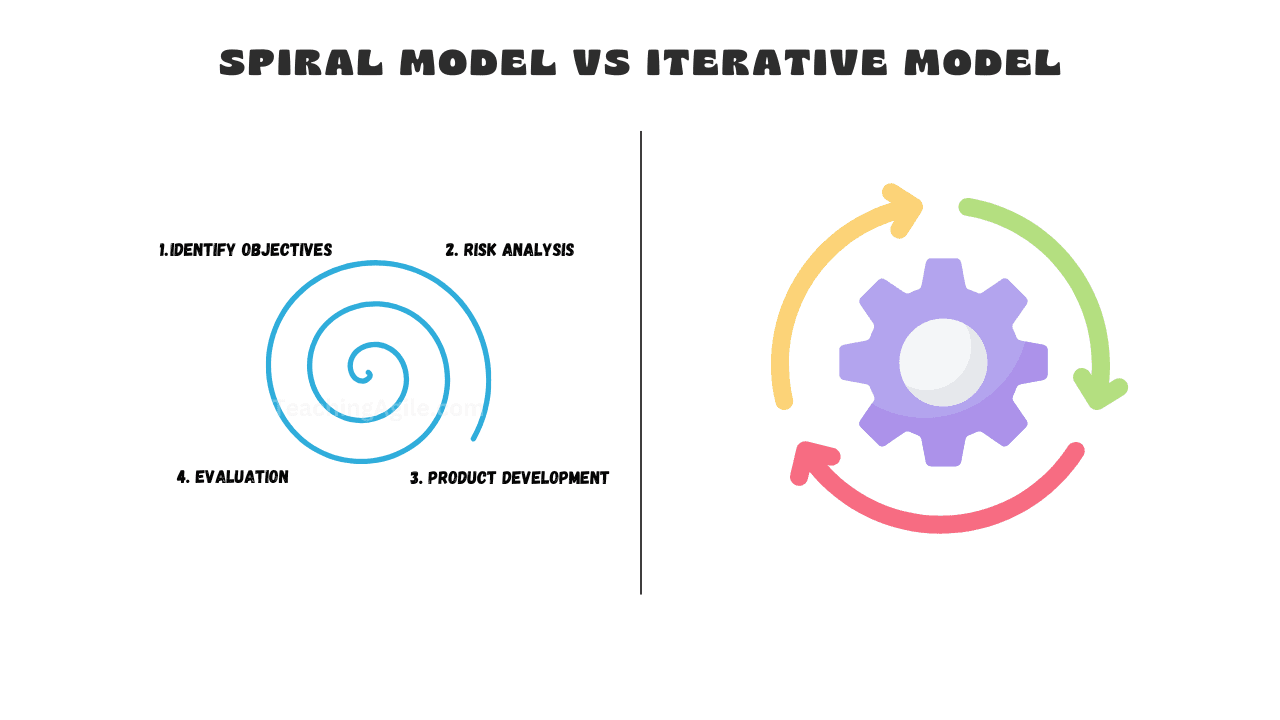 Spiral Model vs Iterative Model Comparison for Software Development Projects
What's the difference between iterative development and the Spiral Model?
While both use repetitive cycles, the Spiral Model adds systematic risk management that transforms how you handle uncertainty.
Unlike the sequential Waterfall approach or rapid Agile methodologies, these models represent different philosophies for iterative development.
The Iterative Model focuses on incremental delivery, while the Spiral Model adds formal risk management to iterative development.
Understanding this distinction is crucial for choosing the right approach for your project's complexity and risk profile.
Iterative Model Philosophy:
Spiral Model Philosophy:
| Aspect | Iterative Model | Spiral Model |
|---|---|---|
| Primary Focus | Feature delivery | Risk analysis and mitigation |
| Iteration Structure | Flexible phases | Fixed 4 phases |
| Decision Points | Informal, continuous | Formal go/no-go gates |
| Risk Management | Implicit through cycles | Explicit dedicated phase |
| Methodology | Single approach | Can change per spiral (meta-model) |
Iterative Model:
Spiral Model:
Key Insight: Iterative models focus on feature progression, while Spiral focuses on risk progression. Each spiral explicitly addresses the biggest risks first, making it a meta-model that can incorporate Waterfall, Agile, or other approaches as needed.
Technical Risk Examples:
Business Risk Examples:
Why Spiral Excels:
Project Characteristics:
Spiral Advantages:
Industries Requiring Formal Processes:
Spiral Benefits:
Project Characteristics:
Iterative Advantages:
Risk Profile:
Why Iterative Works:
Constraint Types:
Iterative Benefits:
When to Combine Methodologies:
Implementation Strategies:
Success Example: A financial platform used Spiral for the trading engine (high-risk, regulatory) and Iterative for the user interface (well-understood, lower risk).
Choose Spiral When:
Choose Iterative When:
| Factor | Favors Spiral | Favors Iterative |
|---|---|---|
| Risk Level | High/Unknown | Low/Manageable |
| Compliance | Regulatory requirements | Minimal formal needs |
| Team Size | Large/Distributed | Small/Co-located |
| Domain Experience | New/Complex | Familiar/Proven |
| Timeline | Long-term/Flexible | Short-term/Urgent |
| Stakeholders | Multiple/Formal | Single/Informal |
Project Context:
Results:
Project Context:
Results:
"Spiral is just complex Iterative"
"Iterative is always faster"
"You can't combine them"
"Spiral requires excessive documentation"
The choice between Spiral and Iterative models depends on your project's risk profile and constraints. Neither is inherently better - they solve different problems.
Choose Spiral when risks are significant, stakes are high, and you need systematic approaches to uncertainty. The investment in formal risk management pays off through reduced failures and stakeholder confidence.
Choose Iterative when risks are manageable, requirements are clear, and speed of delivery is paramount. The lighter process overhead allows maximum focus on feature development and rapid value delivery.
Consider hybrid approaches when projects have mixed characteristics - some components requiring Spiral's systematic risk management, others suitable for simple iterative development.
Unlike choosing between Waterfall and Agile, this decision is primarily about risk management sophistication rather than fundamental development philosophy. Both embrace iteration; the question is whether formal risk analysis adds sufficient value for your context.
The key is matching methodology to context, not forcing projects into predetermined approaches.
Can you transition from Iterative to Spiral Model mid-project?
How do these models handle technical debt differently?
Which model works better for open source software development?
How do these methodologies integrate with modern CI/CD practices?
What happens when requirements are completely unknown at project start?
How do these models support different team sizes?
Can these methodologies be used for non-software projects?
How do these models handle dependencies between project components?
What role does prototyping play in each methodology?
How do these methodologies address security concerns?
Which methodology better supports distributed or remote teams?
How do these models handle changing business priorities during development?
What training and skill requirements do teams need for each model?
How do these methodologies handle performance and scalability requirements?
What metrics should be used to measure success in each methodology?