
Scaling Scrum: Various Approaches and Flavors of Scaling Scrum in Your Organization
 Scaling Scrum: Various approaches and flavors of Scaling Scrum in your organization
Scaling Scrum refers to the process of applying Scrum principles and practices to larger, more complex projects or organizational structures.
Originally designed for small, cross-functional teams working on single projects, Scrum's scalability has been tested and proven in larger initiatives.
💡
This expansion is achieved through various scaling frameworks and practices, each tailored to accommodate the growing complexity and size of projects while retaining the core values of Scrum.
The journey of Scaling Scrum involves several key approaches. The 'Scrum of Scrums' method allows multiple teams working on the same project to coordinate through regular inter-team meetings. Frameworks like Large-Scale Scrum (LeSS) and the Scaled Agile Framework (SAFe) offer structured methods to scale Scrum to larger organizations. Nexus, developed by Scrum.org, and Scrum@Scale provide additional approaches focusing on integration and organizational transformation.
Quick Answer: Scaling Frameworks at a Glance
| Framework | Team Range | Complexity | Best For |
|---|---|---|---|
| Scrum of Scrums | 2-5 teams | Low | Simple multi-team coordination |
| Nexus | 3-9 teams | Medium | Product-focused scaling with one backlog |
| LeSS | 2-8 teams (Basic) / 8+ (Huge) | Medium | Simplicity-focused enterprise scaling |
| SAFe | Any size | High | Large enterprises needing full governance |
| Scrum@Scale | Any size | Medium | Full organizational agile transformation |
| DAD | Any size | Medium-High | Flexible toolbox approach |
| Spotify Model | Any size | Low-Medium | Culture-driven autonomy at scale |
Table Of Contents-
When to Scale Scrum
Not every organization needs to scale Scrum. Consider scaling when you observe these indicators:
Strong signals to scale:
- A single Scrum Team cannot deliver the product increment alone within a Sprint
- Multiple teams are working on the same product with frequent integration conflicts
- Dependencies between teams are causing delays and blocking progress
- The product backlog has grown beyond what one team can manage effectively
- Organizational leadership demands faster delivery across multiple product areas simultaneously
Signals NOT to scale yet:
- Your single Scrum Team is still forming or not yet performing
- Teams are not yet consistently delivering working increments each Sprint
- Basic Scrum practices are not yet established (no clear Definition of Done, no effective retrospectives)
- The complexity comes from process dysfunction rather than genuine product complexity
⚠️
Scaling amplifies both strengths and weaknesses. Fix your single-team Scrum before scaling - otherwise you scale problems, not solutions.
Challenges of Scaling Scrum
Scaling Scrum can present various challenges, including:
- Coordination and communication: As the number of teams and individuals increases, communication and coordination can become more complex. Dependencies multiply exponentially - two teams have one dependency relationship, but five teams have ten.
- Consistency in processes: Ensuring consistency in Scrum practices across multiple teams is essential for effective scaling. Teams may interpret Scrum differently, leading to misaligned expectations.
- Integration of work: Integrating the work of multiple teams and ensuring a cohesive product Increment can be challenging. Technical debt and integration debt accumulate rapidly without deliberate practices.
- Shared Product Backlog management: A single product backlog serving multiple teams requires disciplined refinement and prioritization practices that go beyond single-team Scrum.
- Maintaining agility at scale: Governance, compliance, and coordination overhead can erode the speed and flexibility that made Scrum valuable in the first place.
Approaches to Scaling Scrum
There are several well-known approaches to scaling Scrum. Some of the most popular frameworks include:
Scrum of Scrums
Scrum of Scrums is a coordination technique used in Scrum to manage the collaboration and communication between multiple Scrum Teams working on the same product. It enables the scaling of Scrum principles while ensuring alignment and synchronization of efforts across teams.
Key Practices in Scrum of Scrums:
- Daily Meetings: Scrum of Scrums meetings are conducted daily, typically after the individual Scrum Team's Daily Scrum. Each team sends a representative to this meeting.
- Impediment Resolution: Teams discuss impediments that affect their interdependencies and collaborate on solutions.
- Information Sharing: The meeting serves as a platform for sharing critical information, updates, and progress.
- Backlog Alignment: Teams ensure that their individual backlogs align with the overall product backlog, promoting a shared product vision.
- Four Questions Format: Representatives typically answer: What did my team do since we last met? What will my team do before we meet again? What impediments are in our way? Am I about to put something in another team's way?
When to use Scrum of Scrums: Best for 2-5 teams working on the same product where the primary challenge is coordination rather than structural complexity.
LeSS (Large-Scale Scrum)
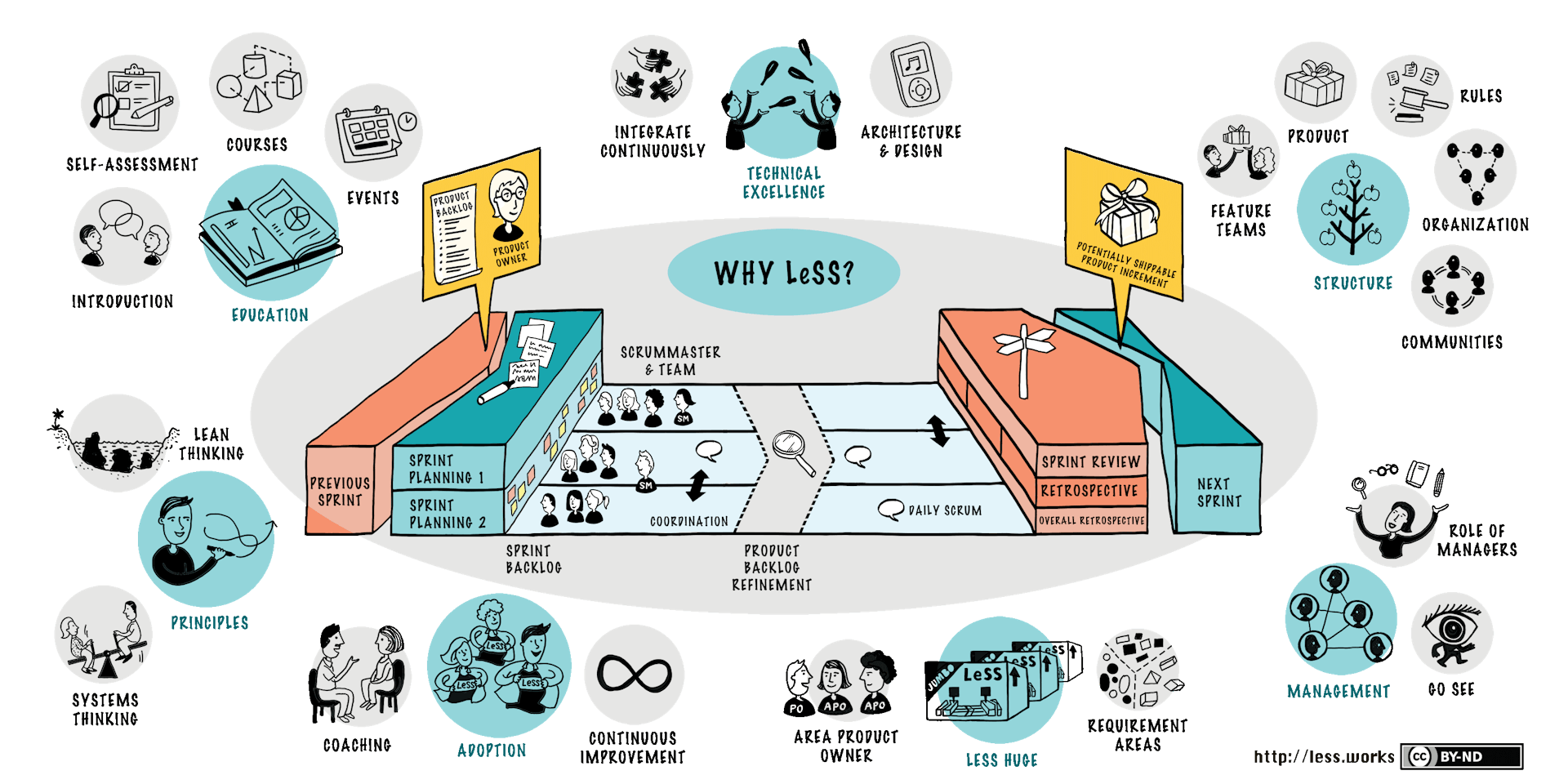
LeSS (opens in a new tab) is a framework that extends Scrum principles to multiple teams collaborating on a single product. Starting with a single Scrum team, LeSS applies Scrum's principles and goals to large-scale projects through clear guidelines and practices. Its simplicity is its strength - LeSS deliberately avoids adding new roles, artifacts, or complexity.
LeSS Principles:
- Empirical Process Control
- Transparency
- More with Less
- Whole Product Focus
- Customer-centric
- Continuous Improvement towards Perfection
- Systems Thinking
- Lean Thinking
- Queuing Theory
Framework Structure of LeSS:
- LeSS offers two configurations: Basic LeSS, designed for two to eight teams (10-50 individuals), and LeSS Huge, tailored for more extensive projects involving over eight teams (50-6000+ individuals). Starting with Basic LeSS is recommended to gain experience before venturing into LeSS Huge.
- One Product Owner: A single Product Owner manages one Product Backlog for all teams, ensuring whole-product thinking.
- One Sprint: All teams run synchronized Sprints of the same length.
- Joint Sprint Review: All teams demonstrate their work together to stakeholders.
- Overall Retrospective: An additional retrospective involving the whole LeSS team to address cross-team improvement opportunities.
When to use LeSS: Best for organizations that value Scrum simplicity and want to scale without heavy governance overhead. Requires strong engineering practices and organizational willingness to de-layer management.
SAFe (Scaled Agile Framework)
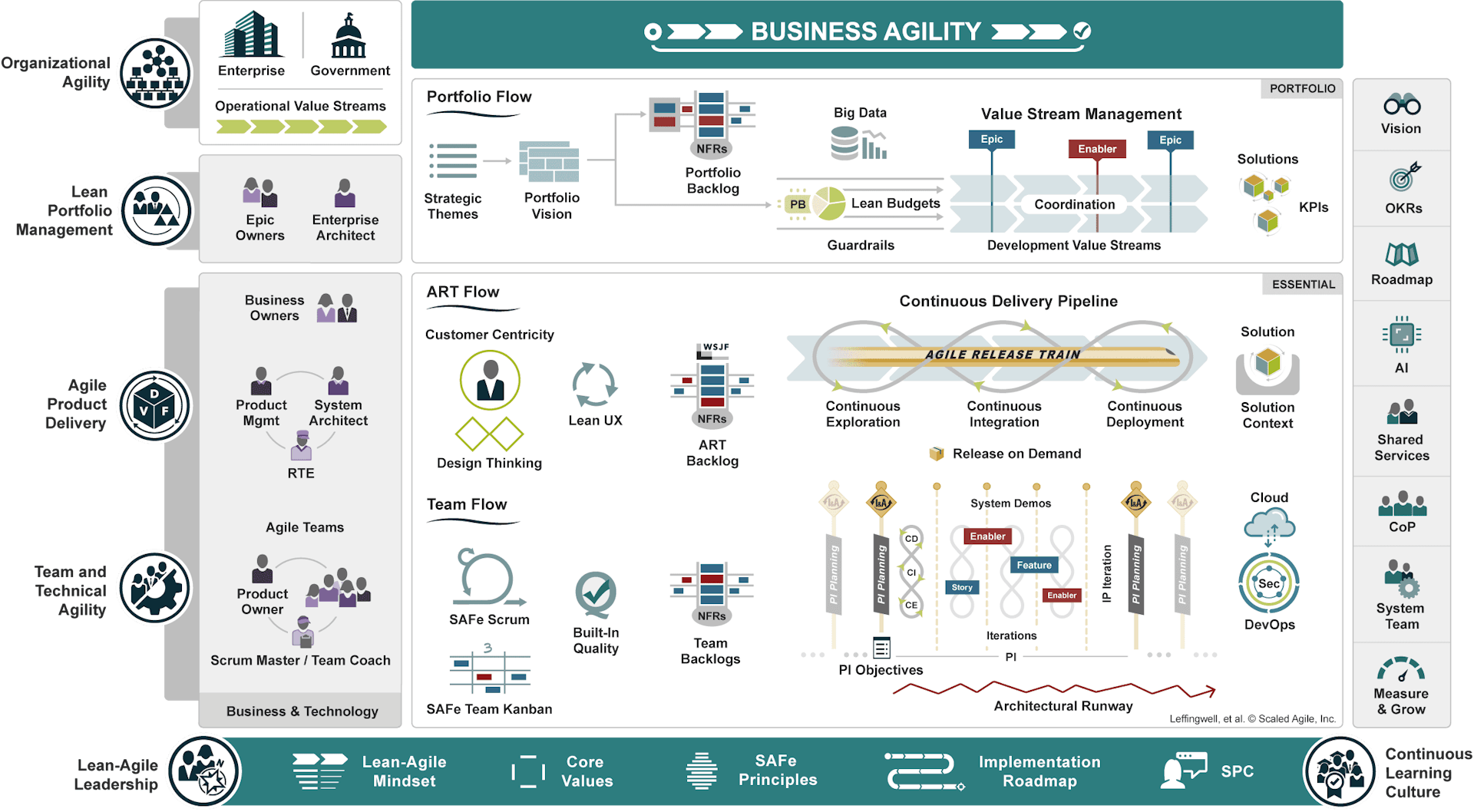
SAFe (opens in a new tab) is a comprehensive framework for implementing Agile practices at a large scale. It provides guidance on roles, responsibilities, work management, and core values to support alignment, collaboration, and efficient delivery across numerous Agile teams. SAFe is founded on three key bodies of knowledge: Agile software development, lean product development, and systems thinking.
SAFe Core Values:
- Alignment
- Built-in quality
- Transparency
- Program Execution
- Leadership
SAFe Configurations:
- Essential SAFe: The most basic configuration - one Agile Release Train (ART) with 5-12 teams
- Large Solution SAFe: For programs requiring multiple ARTs to build large, complex solutions
- Portfolio SAFe: Adds strategic portfolio management and governance
- Full SAFe: The complete configuration for the largest enterprises
Benefits of SAFe Framework:
- Accelerated Time-to-Market: SAFe enhances the ability to respond to customer needs swiftly. By aligning cross-functional Agile teams around value delivery, organizations make quicker decisions, streamline operations, and remain customer-focused.
- Enhanced Quality: Inherent quality is a core SAFe value, emphasizing the integration of quality throughout the development cycle. Scaling Agile with SAFe shifts the focus from last-minute quality checks to a collective responsibility for quality.
- Improved Employee Engagement: SAFe's focus on team autonomy within defined guardrails can increase engagement and ownership.
- Portfolio Alignment: SAFe connects portfolio strategy to team execution through a clear hierarchy of objectives.
When to use SAFe: Best for large enterprises (>500 people) with complex compliance, governance, and portfolio management needs. Requires significant investment in training and coaching.
Nexus
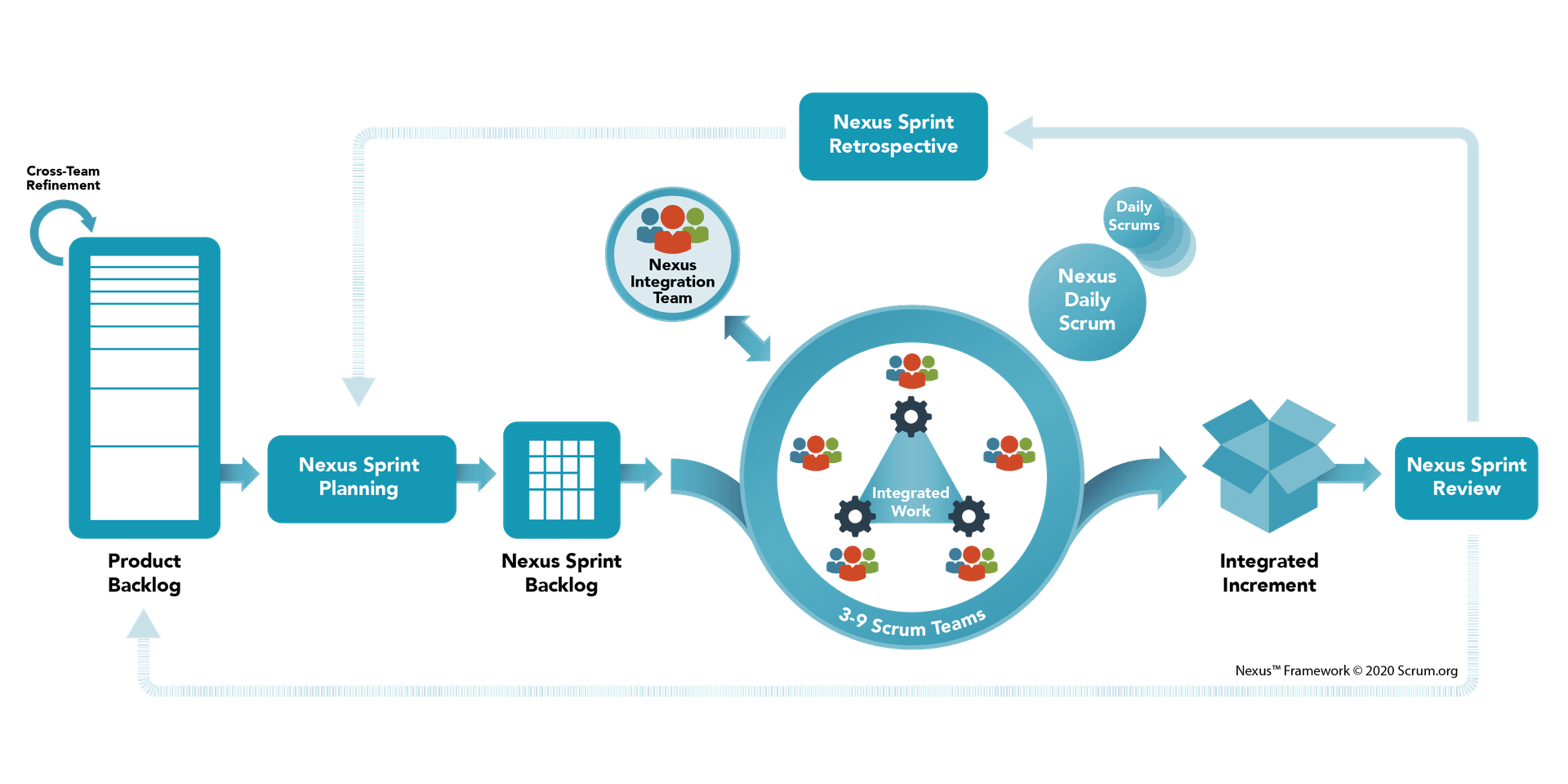
Nexus (opens in a new tab) is a framework specifically designed by Scrum.org (opens in a new tab) to scale Scrum. It builds upon the Scrum framework and adds additional roles and events to facilitate coordination and integration among multiple Scrum teams. The Nexus Integration Team is responsible for managing dependencies and ensuring a unified product increment.
Nexus comprises a group of 3 to 9 Scrum Teams working collaboratively to deliver a single product. Nexus aims to uphold Scrum's empiricism and bottom-up intelligence while creating an environment where multiple Scrum Teams can collectively deliver value beyond what a single team can achieve.
The Nexus Framework Structure:
- Nexus Integration Team (NIT): A new team consisting of the Product Owner, a Scrum Master, and select members from the Scrum Teams. Responsible for coaching teams on integration practices and resolving cross-team dependencies.
- Nexus Sprint Backlog: A view into the Product Backlog items selected for the Sprint across all teams, highlighting dependencies.
- Integrated Increment: The combined output of all Scrum Teams that must meet the Definition of Done each Sprint.
Nexus Events:
- Nexus Sprint Planning: Cross-team planning to minimize dependencies and distribute work
- Nexus Daily Scrum: A short event for Nexus Integration Team members to identify impediments to integration
- Nexus Sprint Review: All teams demonstrate work to stakeholders as one integrated product
- Nexus Sprint Retrospective: Three-part retrospective addressing whole-Nexus, cross-team, and individual team improvements
The Goal of Nexus Framework:
Nexus aims to maximize the value delivered by a group of Scrum Teams working on a single product, reducing complexity and ensuring the delivery of an integrated, meaningful product Increment each Sprint.
When to use Nexus: Best for 3-9 teams building a single product where Scrum.org's empirical approach aligns with organizational values. Lower overhead than SAFe with more structure than pure Scrum of Scrums.
Spotify Model
The Spotify Model (opens in a new tab) is a popular approach to Scaling Scrum, often associated with the music streaming service Spotify. It's an organizational framework designed to foster agility, autonomy, and alignment within large organizations. The model emphasizes the creation of "Squads," small cross-functional teams responsible for specific product areas.
Key Features of the Spotify Model:
- Squads: Small, self-organizing teams with a clear mission and ownership of a specific product area.
- Tribes: Squads are grouped into "Tribes," which are larger collections of related squads.
- Chapters: Consist of individuals with similar skills or interests across different squads. They provide a platform for skill development and knowledge sharing.
- Guilds: Informal communities of practice that allow individuals from different chapters and tribes to come together, share knowledge, and drive improvements.
- Autonomy: The model encourages squads to have a high degree of autonomy in decision-making, fostering a culture of ownership and responsibility.
⚠️
Important: Even Spotify has moved beyond the original "Spotify Model." It was never intended as a prescriptive framework - it was a description of how Spotify worked at a point in time. Copying it without understanding the underlying culture often fails.
Disciplined Agile Delivery (DAD)
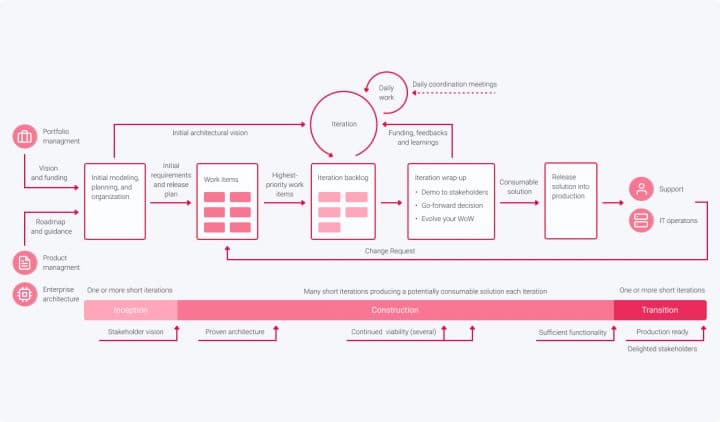
DAD (opens in a new tab) is a process decision framework that builds on the foundation of agile and lean principles. It provides a straightforward guide to help organizations make informed decisions about their agile and lean strategies. DAD addresses a variety of lifecycles, practices, and roles, making it adaptable to different situations.
Key Principles of DAD:
- Choose Your Wow: DAD emphasizes the importance of choosing the right agile and lean practices based on the unique needs of the project or organization.
- Be Awesome at What You're Good At: DAD recognizes that organizations have strengths and existing practices worth preserving. It encourages leveraging these strengths while continuously improving.
- Context Counts: DAD acknowledges that each situation is unique and encourages teams to consider the context when making process decisions.
- Enterprise Awareness: DAD provides guidance for scaling agile practices at an enterprise level, ensuring alignment with organizational goals.
When to use DAD: Best for organizations that want maximum flexibility and already have experienced Agile practitioners who can make good process decisions. Not ideal for organizations seeking a prescriptive framework or just starting their Agile journey.
Scrum@Scale (S@S)
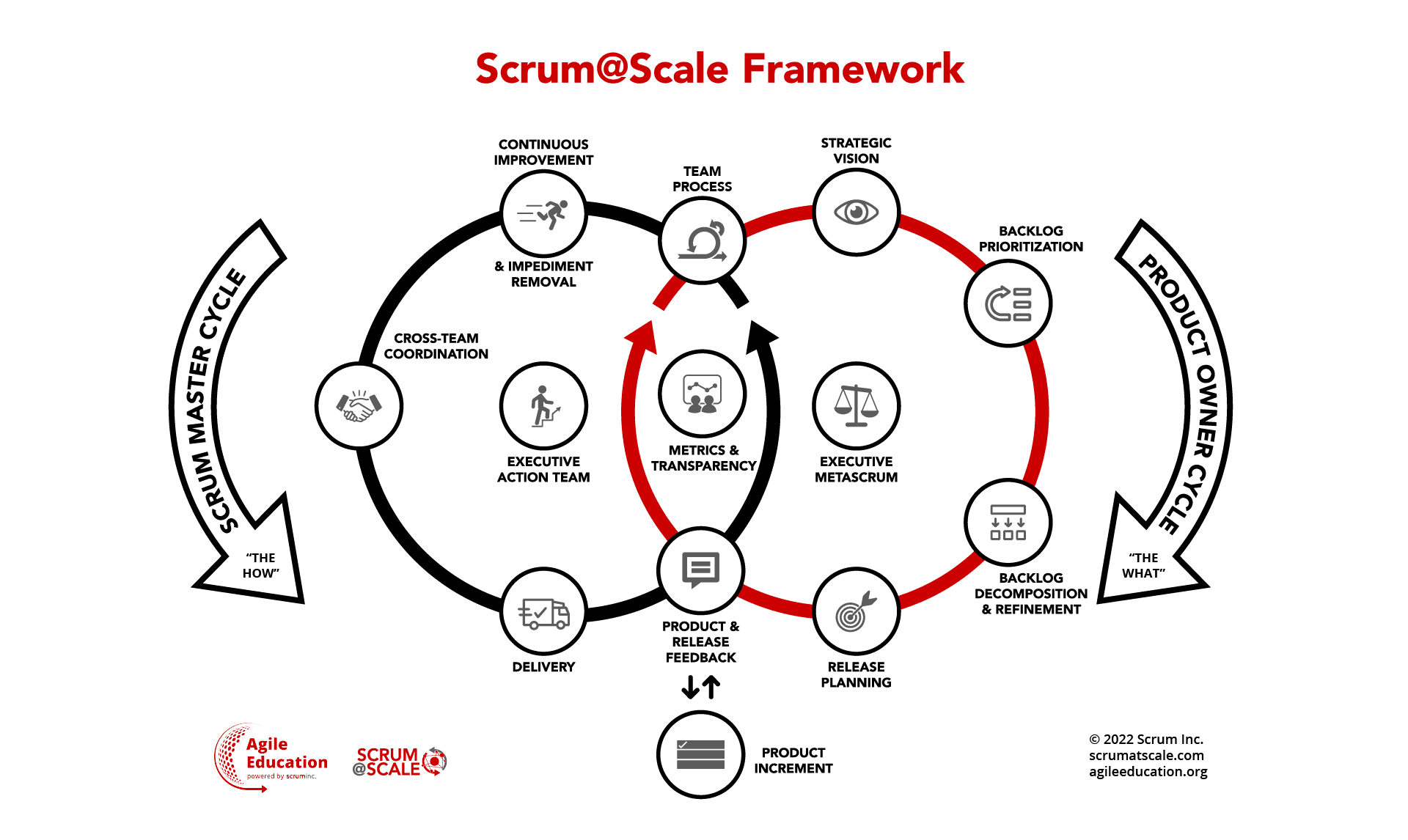
While Scrum can be applied to individual teams, Scrum@Scale is designed to transform the entire organizational culture by scaling Agile practices across multiple teams and ecosystems.
Scrum@Scale draws from Scrum's fundamental principles and complex adaptive systems theory.
In Scrum@Scale, everyone is part of a Scrum Team, and various Scrum Teams come together to form an ecosystem.
It is a suitable framework for large organizations, offering training and certification options.
Core Concepts of S@S:
- Small Teams: Teams typically consist of three to nine members.
- Scaling Across the Organization: Agile practices are scaled across the entire organization.
- Minimum Viable Bureaucracy: Emphasizing minimal bureaucracy to make decisions and execute them efficiently.
- Two Cycles: The Scrum Master Cycle (how work gets done) and the Product Owner Cycle (what gets built) operate in parallel.
Scrum@Scale Events:
In addition to the standard Scrum events, Scaling Scrum introduces Scaled Daily Scrums, where every team member participates, ensuring alignment and collaboration.
Roles in Scrum@Scale:
In Scrum@Scale, the roles of Product Owner and Scrum Master remain, with similar responsibilities. The framework introduces new roles like Chief Product Owner (CPO) and Scrum of Scrums Master (SoSM) to facilitate coordination and alignment.
When to use Scrum@Scale: Best for organizations that want to extend Scrum's principles organization-wide rather than just at the team level. Particularly suitable when the goal is to transform the entire organization's way of working.
Scaling Maturity Model
Organizations evolve through distinct stages when scaling Scrum. Understanding your current stage helps you select the right practices and set realistic expectations.
Stage 1: Coordinated Teams (Months 1-6)
Characteristics:
- Multiple independent Scrum Teams exist but work in silos
- Basic Scrum practiced at team level
- Ad-hoc cross-team coordination
- Integration happens infrequently (end of sprint or later)
Focus areas:
- Establish Scrum of Scrums meetings
- Create a shared Definition of Done
- Begin cross-team backlog refinement
- Identify and reduce major dependencies
Signs you are here: Teams complete their work but integration is painful. The phrase "it works on my team" is common.
Stage 2: Integrated Delivery (Months 7-18)
Characteristics:
- Teams integrate work continuously or at least every Sprint
- Shared Product Backlog actively managed
- A formal scaling framework is in use (Nexus, LeSS, or similar)
- Cross-team dependency management is routine
Focus areas:
- Strengthen automated testing and CI/CD practices
- Formalize the Nexus Integration Team or equivalent
- Improve cross-team Sprint Planning and Reviews
- Measure and reduce lead time for features
Signs you are here: Integration is mostly automated, but portfolio alignment and prioritization across teams remains challenging.
Stage 3: Aligned Organization (Months 19-36)
Characteristics:
- Strategy connects to team-level Sprint Goals
- Business stakeholders actively engaged in Sprint Reviews
- Continuous flow of value from teams to customers
- Metrics drive improvement at team and program level
Focus areas:
- Implement portfolio-level Kanban or SAFe portfolio practices
- Establish an Executive Action Team or equivalent leadership body
- Develop internal Agile coaching capability
- Connect business outcomes to team metrics
Signs you are here: Leadership confidently makes roadmap decisions based on team velocity and capacity. Teams can forecast delivery within reasonable bounds.
Stage 4: Adaptive Enterprise (Month 37+)
Characteristics:
- The organization continuously adapts its scaling approach
- Scaling framework elements are customized to organizational needs
- Agile thinking embedded in business strategy and HR practices
- Innovation and delivery operate at high speed simultaneously
Focus areas:
- Experiment with and evolve the scaling framework itself
- Measure business outcomes rather than process compliance
- Extend Agile practices to non-software departments
- Build organizational resilience and learning capacity
Industry-Specific Scaling Examples
SaaS and Cloud Services
Scaling Scrum for a cloud platform serving millions of users:
- Platform team owns infrastructure Product Backlog items shared with feature teams
- Nexus Integration Team includes Site Reliability Engineers to ensure each Sprint produces a deployable increment
- Feature flags enable multiple teams to integrate code without blocking each other
- Shared on-call rotation across teams reinforces whole-product ownership
- Definition of Done includes automated performance regression tests
Healthcare Technology
Scaling Scrum for an electronic health records system:
- Regulatory compliance items (HIPAA, HL7 FHIR) included in shared Definition of Done
- Nexus Sprint Reviews include clinical stakeholders for direct feedback
- Security review team participates in cross-team Sprint Planning to identify PHI-handling dependencies
- Audit logging and access control requirements treated as cross-cutting concerns owned by Nexus Integration Team
- Dedicated compliance Scrum Team handles regulatory submissions while feature teams continue delivery
Financial Services
Scaling Scrum for a core banking platform:
- Risk and compliance representatives embedded in Nexus Integration Team
- PCI-DSS and SOX compliance requirements captured as program-level Definition of Done criteria
- Quarterly Business Review replaces traditional project steering committee
- Change Advisory Board integrated into Sprint Review cadence rather than being a separate gate
- Three teams: Core Services, Digital Channels, Data and Analytics - each with a sub-backlog but one Program Backlog
E-commerce
Scaling Scrum for a high-traffic retail platform:
- Peak season planning (Black Friday, holiday) done at LeSS Huge Area level
- Performance and load testing included in Definition of Done for all checkout-related stories
- A/B testing framework owned by a platform team, consumed by feature teams
- Mobile and web teams synchronized through shared Sprint cadence to avoid API contract breaks
- Customer support team participates in Sprint Reviews to provide real-world usage feedback
Enterprise DevOps
Scaling Scrum across an enterprise platform engineering organization:
- Infrastructure-as-Code owned by platform team, exposed as self-service capabilities to feature teams
- Scrum@Scale's Executive Action Team drives removal of organizational impediments that teams cannot resolve
- Security scanning integrated into the shared CI/CD pipeline - no team can bypass it
- Inner-source model allows feature teams to contribute to platform team's backlog
- Quarterly PI Planning equivalent used to align roadmaps, even in a LeSS context
Common Scaling Anti-Patterns
Avoid these frequently observed mistakes when scaling Scrum:
Anti-Pattern 1: Scaling Before Single-Team Mastery
Problem: Organizations adopt SAFe or LeSS while individual teams still struggle with basic Scrum practices.
Why it is problematic: Scaling amplifies dysfunction. Poor backlog refinement at the team level becomes chaotic cross-team prioritization at scale. Weak retrospective practices mean improvement never happens at any level.
Fix: Ensure each team can consistently deliver a Done Increment every Sprint before adding a scaling layer. Use a team health check across all Scrum Teams before selecting a framework.
Anti-Pattern 2: Copying the Spotify Model Literally
Problem: Leaders read about Squads, Tribes, Chapters, and Guilds and restructure the entire organization overnight.
Why it is problematic: The Spotify Model was a description of culture, not a prescription for structure. The roles and names without the underlying autonomy, trust, and engineering excellence produce bureaucracy with Agile labels.
Fix: Focus on the principles behind Spotify's success - autonomous teams, high alignment, clear missions - rather than the organizational chart.
Anti-Pattern 3: SAFe as Project Management Theater
Problem: Organizations implement SAFe's ceremonies (PI Planning, ART Sync, etc.) without changing how decisions are actually made.
Why it is problematic: PI Planning that produces a fixed 12-week plan is not Agile PI Planning. If leadership overrides team capacity during PI Planning, teams lose trust in the process quickly.
Fix: PI Planning must be genuinely collaborative. Leadership presents business context; teams negotiate what is achievable. The output is a directional plan, not a contract.
Anti-Pattern 4: One Backlog in Name Only
Problem: A "single Product Backlog" exists on paper, but each team actually works from its own private backlog without proper cross-team refinement.
Why it is problematic: Teams optimize locally and lose whole-product focus. Dependencies are discovered late. The Product Owner loses visibility into actual team capacity.
Fix: Conduct regular cross-team Product Backlog Refinement sessions. The Product Owner should actively manage team capacity and item assignment across the shared backlog.
Anti-Pattern 5: Neglecting the Integration Work
Problem: Teams plan feature work but leave integration tasks off the Sprint Backlog, assuming "it will just work."
Why it is problematic: Integration debt accumulates silently. At the end of a Sprint, teams discover that individual components do not fit together, causing late scrambles and incomplete increments.
Fix: Make integration tasks explicit Sprint Backlog items. The Nexus Integration Team (or equivalent) should own integration readiness, not leave it to heroics at Sprint end.
Anti-Pattern 6: Scaling Frameworks as Excuses for New Silos
Problem: Teams adopt LeSS or Nexus but continue to operate as before, treating the framework events as additional overhead rather than integration opportunities.
Why it is problematic: You pay the coordination cost of scaling without gaining the benefits of whole-product delivery.
Fix: Ensure cross-team events (Nexus Sprint Planning, LeSS Overall Retrospective) are genuinely collaborative. If teams attend but do not change behavior, the Scrum Master for those events needs to facilitate more actively.
Anti-Pattern 7: Ignoring the Human Side of Scaling
Problem: Scaling is treated as a technical or process problem. People concerns - team identity, career paths, psychological safety - are ignored.
Why it is problematic: Teams resist changes they do not understand or that threaten their identity. High turnover and disengagement follow.
Fix: Invest in change management alongside process changes. Explain the "why" clearly. Involve teams in framework selection. Protect team identities within the scaling structure.
Anti-Pattern 8: Never Revisiting the Framework Choice
Problem: An organization adopts SAFe, grows to see it as permanent infrastructure, and never questions whether it still fits.
Why it is problematic: Scaling frameworks are means to an end, not ends in themselves. A smaller, more focused product might need a simpler approach than a growing enterprise adopted years ago.
Fix: Treat your scaling framework choice as an experiment. Regularly inspect whether the framework overhead is justified by the value it enables.
How to Choose the Right Framework
Use this decision guide to narrow your options:
| Situation | Recommended Approach |
|---|---|
| 2-5 teams, same product, simple coordination needed | Scrum of Scrums |
| 3-9 teams, strong Scrum.org alignment, want minimal new roles | Nexus |
| 3-8 teams, value simplicity, willing to restructure management | LeSS Basic |
| >8 teams, complex product domain, value simplicity | LeSS Huge |
| Large enterprise, compliance-heavy, needs full governance | SAFe |
| Want to transform entire organization, not just IT | Scrum@Scale |
| Experienced teams, want maximum flexibility | Disciplined Agile |
💡
No single framework is universally superior. The best framework is the one your organization will actually implement well - prioritize cultural fit and simplicity over feature completeness.
Test Your Knowledge
Quiz on Scaling Scrum
Your Score: 0/15
Question: What does 'Scaling Scrum' primarily refer to?
Conclusion
Scaling Scrum is essential for organizations aiming to navigate the challenges of large-scale product development. The frameworks covered here - Scrum of Scrums, LeSS, SAFe, Nexus, Scrum@Scale, DAD, and the Spotify Model - each offer distinct approaches suited to different organizational contexts.
Key takeaways:
- Scale only after establishing solid single-team Scrum practices
- Choose a framework based on your organization's size, culture, and governance needs
- Invest in the human side of scaling - change management matters as much as process
- Treat your framework choice as an experiment, not a permanent commitment
- Measure outcomes (faster delivery, higher quality, better stakeholder satisfaction) not just process compliance
The goal is not to implement a framework perfectly - it is to deliver more value to customers faster, while keeping teams engaged and the product coherent. Use whichever combination of practices helps you achieve that.
Continuous Improvement in ScrumLearn how continuous improvement principles underpin all scaling frameworks and how to build a culture of ongoing refinement across multiple teams.
Agile Transformation: Complete GuideUnderstand the broader organizational change journey that scaling Scrum is part of, including leadership alignment and cultural transformation.
Definition of Done: The Complete GuideMaster the Definition of Done - the foundation of scaled Scrum. Learn how to create and evolve shared quality standards across multiple teams.
Sprint Planning: Your Guide to Effective Scrum ExecutionUnderstand Sprint Planning mechanics that become the foundation for cross-team planning events in Nexus, LeSS, and SAFe.
Sprint Retrospective: Boost Team PerformanceMaster retrospective practices that scale into LeSS Overall Retrospectives and Nexus Sprint Retrospectives at the multi-team level.
Scrum Product Backlog: Master Essential Agile ArtifactDeep dive into Product Backlog management - a critical practice in scaling where one backlog must serve multiple teams effectively.
Scrum Anti-Patterns: Common Mistakes to AvoidIdentify and avoid the most common Scrum anti-patterns that become amplified when scaling to multiple teams and larger organizations.
Scrum Master: Roles, Responsibilities and SkillsUnderstand the Scrum Master role that evolves into Scrum of Scrums Master and Release Train Engineer when scaling Scrum across teams.
Frequently Asked Questions (FAQs) / People Also Ask (PAA)
How does scaling Scrum differ from scaling project management?
Can Scrum be scaled without adopting a formal framework like SAFe or LeSS?
What is the role of leadership in scaling Scrum successfully?
How do you handle budget and financial governance when scaling Scrum?
How does scaling Scrum work for hardware and embedded systems development?
What is the difference between a Nexus Integration Team and a traditional program management office?
How do remote and distributed teams affect scaling Scrum?
How long does it typically take to see results from scaling Scrum?
How should companies handle team members who resist the scaling framework?
What metrics should organizations track when scaling Scrum?
Can Scrum be scaled in non-software domains like marketing or operations?
How does technical debt affect scaling Scrum, and how should it be managed?
What is the SAFe Agile Release Train (ART) and how does it differ from a single Scrum Team?
How do you scale the Product Owner role across multiple teams?
What is the relationship between scaling Scrum and DevOps?