
Agile Methodology: Values, Principles, and Best Practices
 Agile Methodology: Values, Principles, and Best Practices
Agile methodology is an iterative approach to project management and software development that emphasizes flexibility, collaboration, and continuous delivery of value. Rather than following rigid, sequential processes, Agile divides work into small, manageable increments called iterations or sprints, enabling teams to adapt quickly to changing requirements and deliver working software frequently.
The Agile Manifesto (opens in a new tab), created in 2001 by 17 software developers, established the foundation for modern Agile practices. These pioneers were frustrated with the traditional waterfall approach - a linear, sequential process that proved rigid and inflexible when requirements changed mid-project.
The Agile Manifesto emphasizes flexibility and adaptability over rigid planning. Software development teams worldwide have widely adopted these principles, leading to improved software quality, shorter development cycles, and increased customer satisfaction.
This guide explores the core values, principles, and best practices of Agile methodology. You'll learn when to use Agile, common implementation mistakes, popular frameworks, and strategies for successful transformation.
Quick Answer: Agile Methodology at a Glance
| Aspect | Details |
|---|---|
| Definition | Iterative approach to software development emphasizing flexibility and collaboration |
| Core Values | 4 values from the Agile Manifesto (2001) |
| Principles | 12 guiding principles for Agile teams |
| Popular Frameworks | Scrum, Kanban, XP, SAFe, LeSS |
| Best For | Complex projects with evolving requirements |
| Key Benefit | Faster delivery of value through incremental releases |
| Team Structure | Self-organizing, cross-functional teams |
| Iteration Length | Typically 1-4 weeks (varies by framework) |
Table Of Contents-
- Quick Answer: Agile Methodology at a Glance
- Agile Values
- 12 Agile Principles
- Unboxing the 12 Agile Principles
- Infographic of the Agile Manifesto
- When to Use Agile Methodology
- Popular Agile Frameworks
- Advantages of Agile Methodology
- Disadvantages of Agile Methodology
- Common Agile Implementation Mistakes
- Agile Implementation Roadmap
- Agile Metrics and Success Measurement
- Agile and the Triple Constraint
- Personal Experiences with Agile
- Conclusion
- Quiz
- Continue Reading
- Frequently Asked Questions
Agile Values
The Agile Manifesto outlines four fundamental values. Here are the exact values identified in the Agile Manifesto:
We are uncovering better ways of developing software by doing it and helping others do it. Through this work we have come to value:
- Individuals and interactions over processes and tools
- Working software over comprehensive documentation
- Customer collaboration over contract negotiation
- Responding to change over following a plan
That is, while there is value in the items on the right, we value the items on the left more.
Let us break down these values further.
- Individuals and interactions over processes and tools: Agile prioritizes human collaboration and communication over strict adherence to processes and tools.
- Working software over comprehensive documentation: Agile focuses on delivering functional software rather than producing exhaustive documentation.
- Customer collaboration over contract negotiation: Agile emphasizes working closely with customers to meet their needs and expectations.
- Responding to change over following a plan: Agile is adaptable to change and encourages teams to be flexible and responsive.
These values promote a culture of trust, open communication, and continuous learning.
12 Agile Principles
The Agile Manifesto also provides 12 guiding principles:
Our highest priority is to satisfy the customer through early and continuous delivery of valuable software.
Welcome changing requirements, even late in development. Agile processes harness change for the customer's competitive advantage.
Deliver working software frequently, from a couple of weeks to a couple of months, with a preference to the shorter timescale.
Business people and developers must work together daily throughout the project.
Build projects around motivated individuals. Give them the environment and support they need, and trust them to get the job done.
The most efficient and effective method of conveying information to and within a development team is face-to-face conversation.
Working software is the primary measure of progress.
Agile processes promote sustainable development. The sponsors, developers, and users should be able to maintain a constant pace indefinitely.
Continuous attention to technical excellence and good design enhances agility.
Simplicity--the art of maximizing the amount of work not done--is essential.
The best architectures, requirements, and designs emerge from self-organizing teams.
At regular intervals, the team reflects on how to become more effective, then tunes and adjusts its behavior accordingly.
Unboxing the 12 Agile Principles
-
Prioritizing customer satisfaction through early and continuous delivery of valuable software:
Focus on delivering value to the customer quickly by breaking down the project into smaller increments. For example, a team working on an e-commerce website could first deliver the shopping cart feature to provide immediate client value.
-
Welcoming changing requirements, even late in development:
Embrace change and adapt to new requirements throughout the project. In a mobile app project, the client might request an additional social media sharing feature after the initial development has started. A flexible team would incorporate the change rather than resist it.
-
Delivering working software frequently:
Aim to release functional software in short timeframes. A team working on a project management tool could release a basic version with core features, then add enhancements in subsequent releases. This allows for faster feedback and improvement.
-
Collaborating with customers throughout the project:
Maintain open communication with clients, involving them in the development process to meet their needs. In a website redesign project, a team could regularly share progress with the client, seeking input on design and functionality decisions.
-
Building projects around motivated individuals and trusting them to get the job done:
Empower team members by giving them the resources and autonomy needed to complete their tasks. For example, a software developer with the freedom to choose the best programming language for a specific job will likely be more engaged and productive.
-
Using face-to-face communication whenever possible:
Prioritize in-person communication to minimize misunderstandings and improve collaboration. Holding regular stand-up meetings can help keep everyone informed and aligned on project goals in a project involving multiple teams.
-
Measuring progress primarily through working software:
Focus on delivering functional software as the primary measure of progress. In a content management system project, a team could prioritize developing a working prototype over extensive documentation or detailed plans.
-
Maintaining a sustainable work pace:
Encourage a healthy work-life balance and avoid burnout by setting realistic expectations and deadlines. In a long-term project, avoiding excessive overtime can help maintain team morale and productivity.
-
Striving for technical excellence and good design:
Foster a culture of continuous improvement and technical mastery. A team working on a web application could invest time in refactoring code or adopting new technologies to improve performance and maintainability.
-
Keeping things simple and focusing on what's necessary:
Focus on delivering essential features and removing unnecessary complexity. In a project to create a user registration system, a team could prioritize core functionality like account creation and authentication while deferring less critical features for later releases.
-
Allowing self-organizing teams to make decisions:
Encourage teams to take ownership of their work and make decisions collectively. In a project to build a new API, the team could decide on the best architectural approach based on their collective knowledge and expertise.
-
Reflecting on the team's performance and adjusting as needed:
Regularly review and evaluate the team's performance to identify areas for improvement. After completing a major project milestone, a team could hold a retrospective meeting to discuss what worked well, what could be improved, and how to address challenges moving forward.
Infographic of the Agile Manifesto
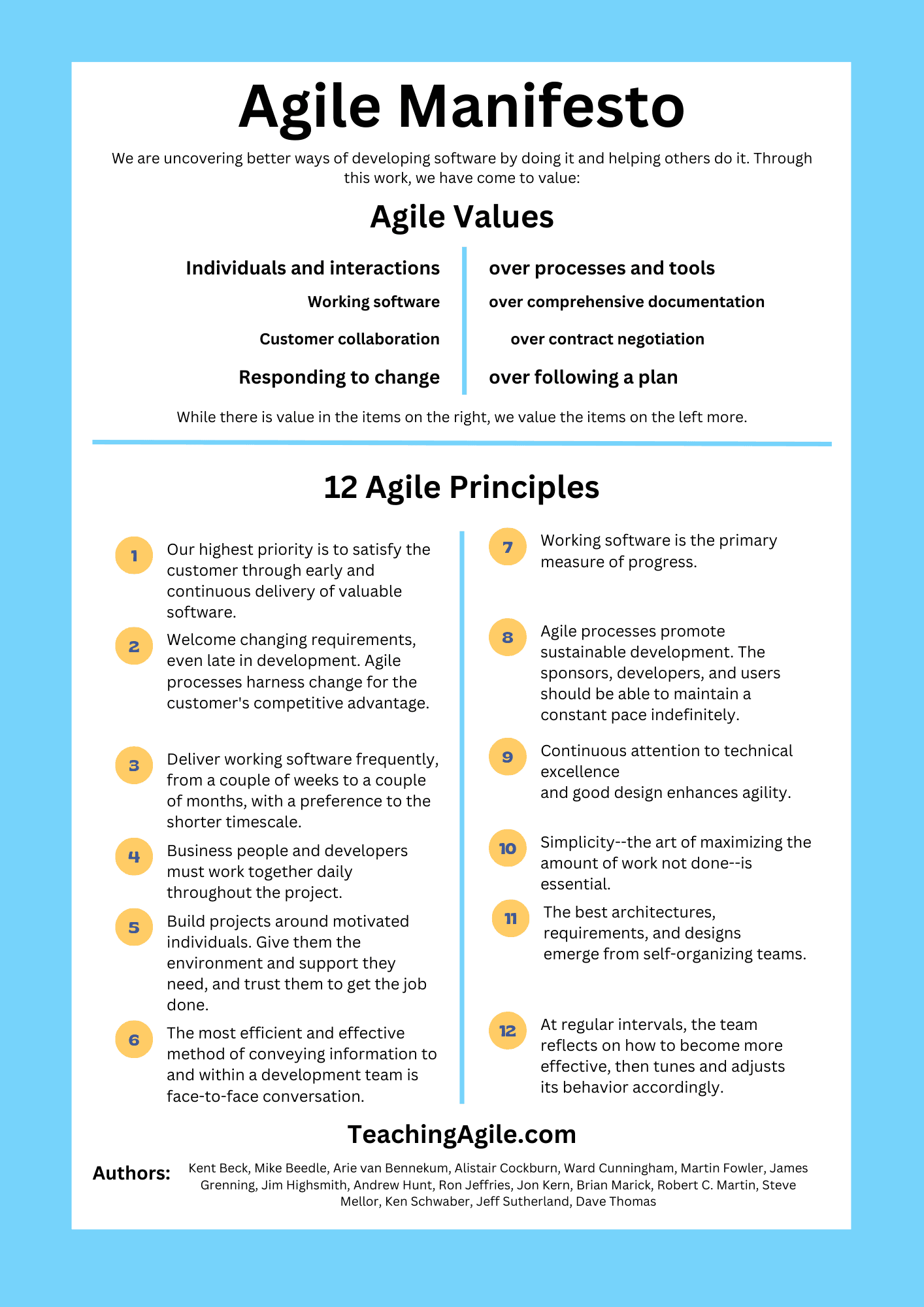
Here is an infographic of the Agile Manifesto that covers the Agile Values and Agile Principles.
 Infographic of the
Agile Manifesto
Infographic of the
Agile Manifesto
When to Use Agile Methodology
Agile methodology is particularly effective in specific contexts where its iterative, flexible approach provides maximum benefit. Understanding when to adopt Agile helps teams make informed decisions about their project management approach.
8 Ideal Scenarios for Agile
1. Projects with Evolving Requirements
When requirements are expected to change frequently or are not fully defined at the project start, Agile's iterative approach allows teams to adapt without derailing progress. This is common in innovative product development or emerging market spaces.
2. Complex Product Development
For complex products where the end solution emerges through experimentation and learning, Agile enables teams to validate assumptions quickly through working increments rather than extensive upfront planning.
3. Customer-Centric Development
When customer feedback and collaboration are critical to success, Agile's emphasis on frequent delivery and customer involvement ensures the product evolves based on real user needs rather than assumptions.
4. Time-to-Market Pressure
Organizations needing to release minimum viable products (MVPs) quickly to capture market opportunities benefit from Agile's focus on delivering working software in short iterations.
5. Innovation and Experimentation
Projects requiring experimentation, rapid prototyping, or exploration of new technologies thrive under Agile, which encourages learning through iteration and welcomes changing direction based on discoveries.
6. Cross-Functional Team Collaboration
When success depends on tight collaboration between developers, designers, product managers, and stakeholders, Agile practices like daily stand-ups and sprint reviews facilitate communication.
7. Continuous Improvement Environments
Organizations committed to continuous improvement and technical excellence benefit from Agile's built-in reflection practices (retrospectives) and emphasis on sustainable development.
8. Startup and Scale-up Environments
Early-stage companies operating in uncertain environments with limited resources benefit from Agile's emphasis on delivering value quickly and adapting based on market feedback.
⚠️
When Agile May Not Be Ideal: Projects with fixed requirements, strict regulatory constraints, predictable processes, or scenarios requiring extensive documentation upfront may benefit from traditional approaches or hybrid methodologies.
Popular Agile Frameworks
Agile is not a single methodology but rather an umbrella term for various frameworks that implement Agile principles. Each framework offers unique practices and processes suited to different team sizes, project types, and organizational contexts.
Scrum
Scrum is the most widely adopted Agile framework, providing a structured approach to iterative development through fixed-length iterations called Sprints (typically 2-4 weeks).
Key Elements:
- Roles: Product Owner, Scrum Master, Developers
- Events: Sprint Planning, Daily Scrum, Sprint Review, Sprint Retrospective
- Artifacts: Product Backlog, Sprint Backlog, Increment
- Best For: Complex product development requiring regular inspection and adaptation
Kanban
Kanban is a visual management system emphasizing continuous flow, work-in-progress (WIP) limits, and just-in-time delivery. Unlike Scrum's time-boxed sprints, Kanban operates as a continuous flow system.
Key Elements:
- Visualization: Kanban board showing work stages
- WIP Limits: Constraints on work in each stage
- Flow Management: Focus on smooth, continuous delivery
- Best For: Operational work, support teams, and projects requiring flexible prioritization
Extreme Programming (XP)
Extreme Programming (XP) is an Agile software development methodology that emphasizes technical excellence and engineering practices to deliver high-quality code.
Key Elements:
- Engineering Practices: Pair programming, test-driven development (TDD), continuous integration
- Customer Involvement: On-site customer, user stories
- Sustainable Pace: 40-hour work weeks, no overtime
- Best For: Software teams prioritizing code quality and technical excellence
Feature-Driven Development (FDD)
Feature-Driven Development is a model-driven, short-iteration methodology that organizes work around features rather than user stories or tasks.
Key Elements:
- Five Processes: Develop overall model, build feature list, plan by feature, design by feature, build by feature
- Feature-Centric: Development organized around client-valued functionality
- Regular Builds: Frequent integration and builds
- Best For: Larger teams with more predictable requirements
Scaled Agile Frameworks
For organizations implementing Agile across multiple teams or at enterprise scale, specialized frameworks provide structure and coordination:
- SAFe (Scaled Agile Framework): Comprehensive framework for enterprise-wide Agile adoption
- LeSS (Large-Scale Scrum): Extension of Scrum principles to multiple teams
- Scrum@Scale: Framework for scaling Scrum through the Scrum of Scrums concept
- Disciplined Agile (DA): Hybrid toolkit approach combining various methodologies
Choosing a Framework: Many organizations start with Scrum for its clear structure, then adapt or combine practices from other frameworks as they mature in their Agile journey.
Advantages of Agile Methodology
Agile methodology offers numerous benefits that have driven its widespread adoption across industries:
1. Increased Customer Satisfaction
Frequent delivery of working software and regular customer involvement ensure products meet actual user needs rather than assumptions. Customers see progress early and can provide feedback that shapes the final product.
2. Enhanced Collaboration and Communication
Daily stand-ups, collaborative planning, and cross-functional teams break down silos and foster transparent communication. Teams work together toward shared goals rather than in isolated departments.
3. Higher Quality Products
Continuous testing, regular code reviews, and emphasis on technical excellence result in fewer defects and more maintainable code. Quality is built in rather than inspected in.
4. Faster Time-to-Market
Incremental delivery enables organizations to release MVPs quickly and add features iteratively. This approach captures market opportunities faster than waiting for complete feature sets.
5. Greater Ability to Adapt to Change
Agile embraces changing requirements as opportunities to deliver more value. Short iterations allow teams to pivot based on market feedback, competitive landscape, or technology changes.
6. Improved Risk Management
Regular inspection and adaptation identify problems early when they're cheaper to fix. Frequent releases reduce the risk of large-scale project failure.
7. Increased Team Morale
Self-organizing teams, sustainable pace, and focus on motivated individuals create engaging work environments. Teams have autonomy and ownership over their work.
8. Better Visibility and Control
Transparent workflows, burndown charts, and frequent stakeholder reviews provide clear visibility into project status. Stakeholders can make informed decisions based on actual progress.
Disadvantages of Agile Methodology
While Agile offers significant benefits, organizations should be aware of potential challenges:
1. Requires Cultural Shift
Organizations accustomed to traditional command-and-control management must embrace empowering teams, accepting change, and collaborative decision-making - a difficult cultural transformation.
2. Demands Experienced Team Members
Agile's self-organizing nature requires mature, skilled team members who can make decisions, estimate work accurately, and collaborate effectively without excessive oversight.
3. Limited Comprehensive Documentation
Agile prioritizes working software over extensive documentation. This can create challenges for maintenance, knowledge transfer, or regulatory compliance in certain industries.
4. Potential for Scope Creep
The flexibility to accommodate change can lead to scope creep if Product Owners don't effectively manage and prioritize the backlog. Without discipline, projects can lose focus.
5. Requires Active Customer Involvement
Agile depends on regular customer feedback and involvement. If customers are unavailable or disengaged, teams may build the wrong product or make incorrect assumptions.
6. Challenging for Fixed-Price Contracts
Traditional fixed-scope, fixed-price contracts conflict with Agile's embrace of changing requirements. Contract structures must adapt to Agile's iterative nature.
7. Can Be Difficult to Scale
Scaling Agile to large organizations with multiple teams requires additional frameworks (SAFe, LeSS) and careful coordination. Small-team practices don't always translate directly to enterprise scale.
8. Not Suitable for All Project Types
Projects with fixed requirements, strict regulatory constraints, or highly predictable processes may not benefit from Agile's flexibility and may incur unnecessary overhead.
Common Agile Implementation Mistakes
Organizations transitioning to Agile often encounter predictable pitfalls. Understanding these common mistakes helps teams avoid them and achieve successful Agile adoption.
Mistake #1: Agile in Name Only ("Faux Agile")
Problem: Teams claim to be Agile but continue waterfall practices with Agile terminology. They hold "sprints" but don't deliver working software, or maintain command-and-control management disguised as Agile roles.
Why It's Problematic: Teams get none of Agile's benefits while experiencing overhead from ceremonies and meetings. This breeds cynicism and resistance to genuine Agile practices.
Fix: Commit to Agile values and principles, not just practices. Focus on delivering working software frequently, embracing change, and empowering teams to self-organize.
Mistake #2: Skipping Retrospectives
Problem: Teams skip Sprint Retrospectives due to time pressure or perceive them as unnecessary.
Why It's Problematic: Without regular reflection and adaptation, teams repeat mistakes and miss opportunities for improvement. Continuous improvement is a core Agile principle.
Fix: Protect retrospective time as sacred. Make retrospectives actionable by identifying specific improvements and tracking their implementation.
Mistake #3: No Dedicated Product Owner
Problem: Product Owner role is assigned part-time or shared among multiple people. The team lacks clear direction and prioritization.
Why It's Problematic: Without a dedicated, empowered Product Owner, teams build the wrong features, struggle with unclear priorities, and make assumptions about customer needs.
Fix: Assign a full-time Product Owner with authority to make product decisions. Provide training on backlog management and stakeholder engagement.
Mistake #4: Large User Stories and No Definition of Done
Problem: Teams work with vague, large user stories without a clear Definition of Done. "Done" means different things to different team members.
Why It's Problematic: Large stories can't be completed in a sprint, leading to carried-over work. Without a clear Definition of Done, quality varies and technical debt accumulates.
Fix: Break stories into small, completable increments. Create a team Definition of Done covering code quality, testing, documentation, and deployment criteria.
Mistake #5: Ignoring Technical Excellence
Problem: Teams focus solely on velocity and feature delivery while neglecting code quality, automated testing, and refactoring.
Why It's Problematic: Technical debt accumulates, slowing future development. The codebase becomes fragile and difficult to change - contradicting Agile's emphasis on adapting to change.
Fix: Invest in automated testing, continuous integration, and regular refactoring. Include technical excellence criteria in the Definition of Done.
Mistake #6: Treating Scrum Master as a Project Manager
Problem: Organizations rename Project Managers to "Scrum Masters" without changing responsibilities. The Scrum Master assigns tasks and tracks individual performance.
Why It's Problematic: This defeats Agile's emphasis on self-organizing teams. Team members wait for assignments rather than collaborating to achieve Sprint Goals.
Fix: Understand that Scrum Masters serve the team by removing impediments and coaching Agile practices - not by managing tasks or people. Provide proper Scrum Master training.
Mistake #7: No Real Customer Involvement
Problem: Teams build products without regular customer feedback, relying on proxy stakeholders or outdated requirements documents.
Why It's Problematic: Without real customer involvement, teams build features that don't address actual needs, discovering misalignment only at final delivery.
Fix: Establish regular customer touchpoints through Sprint Reviews, user testing sessions, and early access programs. Make customer feedback visible and actionable.
Mistake #8: Scaling Too Quickly
Problem: Organizations attempt to scale Agile across the entire organization before teams master basic practices. They adopt complex scaling frameworks (SAFe, LeSS) prematurely.
Why It's Problematic: Teams struggle with basic Agile practices while also dealing with scaling complexity. Success requires mastery of fundamentals first.
Fix: Start with one or two pilot teams. Let them mature their Agile practices (6-12 months) before expanding. Learn from pilot successes and failures before scaling.
Agile Implementation Roadmap
Successfully implementing Agile requires a structured approach that balances planning with experimentation. This roadmap provides a phased approach to Agile adoption.
Phase 1: Assessment and Preparation (1-3 months)
Assess Current State
- Evaluate existing processes, team structure, and organizational culture
- Identify pain points in current development approach
- Determine readiness for Agile adoption
Build Foundation
- Secure executive sponsorship and commitment
- Educate leadership on Agile values and principles
- Select pilot team(s) with favorable conditions for success
Provide Training
- Train Product Owners on backlog management and stakeholder engagement
- Train Scrum Masters (if using Scrum) on servant leadership and facilitation
- Provide team training on Agile values, principles, and selected framework
Phase 2: Pilot Implementation (3-6 months)
Launch Pilot Team(s)
- Start with 1-2 teams in low-risk product areas
- Implement chosen Agile framework (typically Scrum or Kanban)
- Establish regular ceremonies and rhythms
Build Supporting Infrastructure
- Set up collaboration tools (Jira, Azure DevOps, etc.)
- Establish CI/CD pipelines for automated testing and deployment
- Create team workspaces conducive to collaboration
Monitor and Adapt
- Track key metrics (velocity, quality, team satisfaction)
- Hold regular retrospectives to identify improvements
- Adjust practices based on what's working and what isn't
Demonstrate Success
- Showcase pilot results to leadership and broader organization
- Document lessons learned and best practices
- Build case for broader rollout
Phase 3: Scaling and Optimization (6-18 months)
Expand Gradually
- Roll out Agile to additional teams based on pilot learnings
- Adapt practices to fit different team contexts
- Avoid forcing one-size-fits-all approach
Establish Communities of Practice
- Create Scrum Master and Product Owner communities
- Share knowledge and solve common challenges
- Develop internal coaching capability
Optimize Across Teams
- Address cross-team dependencies and coordination
- Implement scaling framework if needed (SAFe, LeSS, Scrum@Scale)
- Align Agile teams with organizational strategy
Continuous Improvement
- Regularly assess Agile maturity and identify areas for growth
- Invest in advanced training and coaching
- Celebrate successes and learn from failures
Timeline Flexibility: These timelines are estimates. Organizations may move faster or slower based on culture, size, and complexity. Focus on sustainable change over speed.
Agile Metrics and Success Measurement
Measuring Agile success requires balanced metrics that reflect value delivery, quality, team health, and continuous improvement. Avoid focusing solely on velocity, which can drive counterproductive behaviors.
Value Delivery Metrics
1. Customer Satisfaction
- Net Promoter Score (NPS) or Customer Satisfaction Score (CSAT)
- Customer feedback themes from Sprint Reviews
- Feature adoption rates and usage metrics
2. Time-to-Market
- Lead time: Time from feature request to production
- Cycle time: Time from starting work to completion
- Release frequency: How often new value reaches customers
3. Business Value Delivered
- Percentage of features actively used by customers
- Revenue impact of delivered features
- Achievement of business objectives and OKRs
Quality Metrics
1. Technical Quality
- Defect density: Bugs per feature or per 1000 lines of code
- Escaped defects: Bugs found in production vs. during development
- Technical debt ratio: Time spent on new features vs. technical debt
2. Code Health
- Code coverage: Percentage of code covered by automated tests
- Code complexity metrics
- Build success rate and build time
Team Health Metrics
1. Team Satisfaction
- Regular team health checks and surveys
- Retrospective action item completion rate
- Team retention and turnover
2. Sustainable Pace
- Sprint overtime hours
- Sprint goal achievement rate
- Work-life balance indicators
Process Metrics
1. Sprint Metrics (for Scrum Teams)
- Sprint goal success rate
- Sprint commitment reliability
- Velocity trends (for planning, not as a performance target)
2. Flow Metrics (for Kanban Teams)
- Throughput: Number of items completed per time period
- Work-in-progress (WIP) adherence
- Flow efficiency: Active work time vs. waiting time
⚠️
Metrics Caution: Metrics should inform improvement, not drive individual performance evaluation. Teams optimize for what's measured - ensure metrics encourage desired behaviors like quality, collaboration, and customer value.
Agile and the Triple Constraint
Agile methodology positively impacts the triple constraint (time, cost, and scope) by:
- Time: Delivering working software in shorter iterations, leading to faster time-to-market.
- Cost: Reducing waste and improving resource utilization through iterative planning and prioritization.
- Scope: Allowing for flexibility in scope changes, ensuring that the most valuable features are developed and delivered.
Personal Experiences with Agile
Incorporating Agile methodology into software development projects has led to numerous positive outcomes, including:
- Improved communication: Agile has fostered better collaboration and understanding among team members by emphasizing face-to-face interactions and frequent touchpoints.
- Adaptability: In one project, we experienced significant changes in requirements midway through development. Agile allowed us to adapt and pivot quickly, ensuring the project's success.
- Increased transparency: Agile practices like daily stand-ups and Kanban boards have provided greater visibility into project progress, allowing stakeholders to make informed decisions.
- Focus on value: Agile's emphasis on prioritizing valuable features and working software has led to higher-quality products that better meet customer needs.
If the Agile methodology interests you, consider getting certified in one of the Agile frameworks. Here is an article that explains the various Agile Certifications you can consider for your career.
Conclusion
In conclusion, Agile methodology offers a flexible, customer-centric approach to software development that emphasizes collaboration, adaptability, and continuous improvement.
By understanding and adopting its values, principles, and practices, teams can overcome the challenges of traditional development methodologies and deliver high-quality software that meets and exceeds customer expectations.
Quiz
Quiz on Agile Methodology
Your Score: 0/15
Question: Which of the following best defines Agile methodology?
Continue Reading
An Agile ExampleDiscover how a financial services company successfully transformed its software development process by implementing Agile methodology, resulting in improved customer satisfaction and team dynamics.
Agile Certifications: A Comprehensive Guide to Boost Your CareerDiscover the various Agile certifications and how they can help you advance your career. Compare the benefits, drawbacks, and the triple constraint in this detailed guide
Learn about Software Development Life Cycle (SDLC)Get an overview of the Software Development Life Cycle (SDLC), and learn about the key phases and activities involved.
Waterfall model in SDLCDiscover the ins and outs of the Waterfall model, a fundamental Software Development Life Cycle (SDLC) methodology. Learn its advantages and disadvantages.
Agile vs. WaterfallDiscover the differences between Agile and Waterfall methodologies in project management, and learn how to choose the best approach for your projects.
Effective Requirements Gathering: Techniques and TipsDiscover effective strategies for business analysts to master requirements gathering, ensuring projects are built on clear, actionable requirements.
Frequently Asked Questions (FAQs) / People Also Ask (PAA)
Are Agile and Scrum the same or different?
Can Agile methods be applied to non-software projects?
Can Agile and Waterfall methodologies be integrated successfully?
How does Agile methodology support remote and distributed teams?
Are Agile and DevOps methodologies of the same nature?
How does Agile compare to Lean methodology?
What are the roles and responsibilities of an Agile coach?
How does Agile methodology differ from Six Sigma?
How does Agile handle technical debt?
How does Agile support compliance and regulatory requirements?
How should organizations measure ROI of Agile transformation?
How does Agile support innovation versus production work?
How does Agile handle dependencies between multiple teams?
What is the difference between Agile and Design Thinking, and how do they work together?
How should Agile teams handle fixed-price, fixed-scope contracts?